
Short on time? Summarize with AI
Open this article in your favorite AI assistant for an instant summary.
In this article
- What is a graft?
- Grafts vs. hairs: reading a quote correctly
- Graft estimates by Norwood stage
- Your donor area sets the limit
- How a surgeon assesses your donor area
- What else changes your number
- How graft count affects cost
- Get a personal estimate
- How many grafts for a hairline?
- How many grafts for the crown?
- One session or two?
- Planning for future loss: two illustrative examples
- Density: what's realistic
- The math behind a graft estimate
- How Turkish-trained surgeons plan graft counts
- Mistakes to avoid when comparing graft counts
- How to take photos for an accurate estimate
What is a graft?
A graft is a follicular unit — a natural group of one to four hairs that grow together. When surgeons talk about 2,000 grafts, that usually means 4,000 or more individual hairs. Single-hair grafts create a soft hairline; two- to four-hair grafts build density behind it.
Grafts vs. hairs: reading a quote correctly
Some clinics quote hairs rather than grafts, and the two numbers are easy to confuse. Because a graft holds one to four hairs, the same session can be described as 2,500 grafts or as 5,000 or more hairs. Neither is misleading on its own, but comparing one clinic's hair count with another's graft count makes the larger number look like a better deal.
| Graft type | Hairs | Where it's placed | Why |
|---|---|---|---|
| Single-hair | 1 | Front edge of the hairline and temple points | Creates a soft, irregular edge that looks natural up close |
| Two-hair | 2 | Just behind the front edge | Adds body while keeping the transition soft |
| Three- to four-hair | 3–4 | Frontal core, mid-scalp and crown center | Builds the most visual density per incision |
Your donor area decides the mix. A donor zone rich in three-hair units can achieve more coverage with fewer grafts than one made up mostly of single-hair units, which is one reason two people at the same Norwood stage receive different estimates.
When you compare quotes, ask for the plan in grafts and, if possible, the expected split by hair count.
Graft estimates by Norwood stage
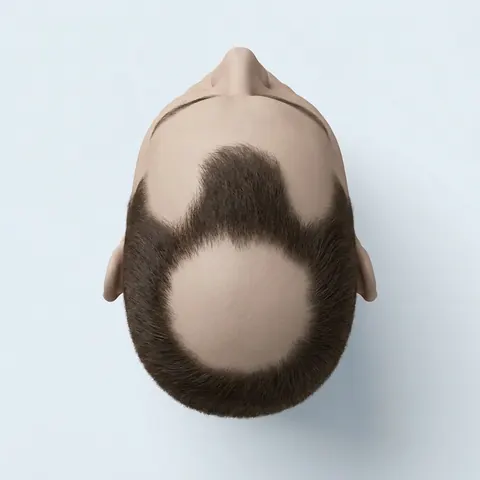
The Norwood scale describes male pattern hair loss in seven stages. These ranges are typical starting points:
| Norwood stage | Pattern | Typical grafts |
|---|---|---|
| 2 | Mild temple recession | 800–1,500 |
| 3 | Receding hairline | 1,500–2,500 |
| 3 vertex | Recession + crown | 2,000–3,000 |
| 4 | Deeper recession + crown | 2,500–3,500 |
| 5 | Bridge thinning | 3,000–4,000 |
| 6–7 | Advanced loss | 4,000+ (often 2 sessions) |
For women, the Ludwig scale describes diffuse thinning; female plans usually range from 1,000 to 2,500 grafts.
Your donor area sets the limit
The back and sides of your scalp contain a finite supply of permanent follicles — often 6,000 to 8,000 safely extractable grafts over a lifetime. A good surgeon plans for the future: if your loss is likely to progress, some grafts should be reserved. Over-harvesting in one session can leave a thin, patchy donor area that's hard to fix.
How a surgeon assesses your donor area
Two scalps can look equally full and still have very different donor capacity. Before recommending a number, a surgeon examines the donor zone, usually the back and sides between the ears, in more detail than a photo can show.
blog-grafts-donor-area-dermatoscope.jpg · 16:9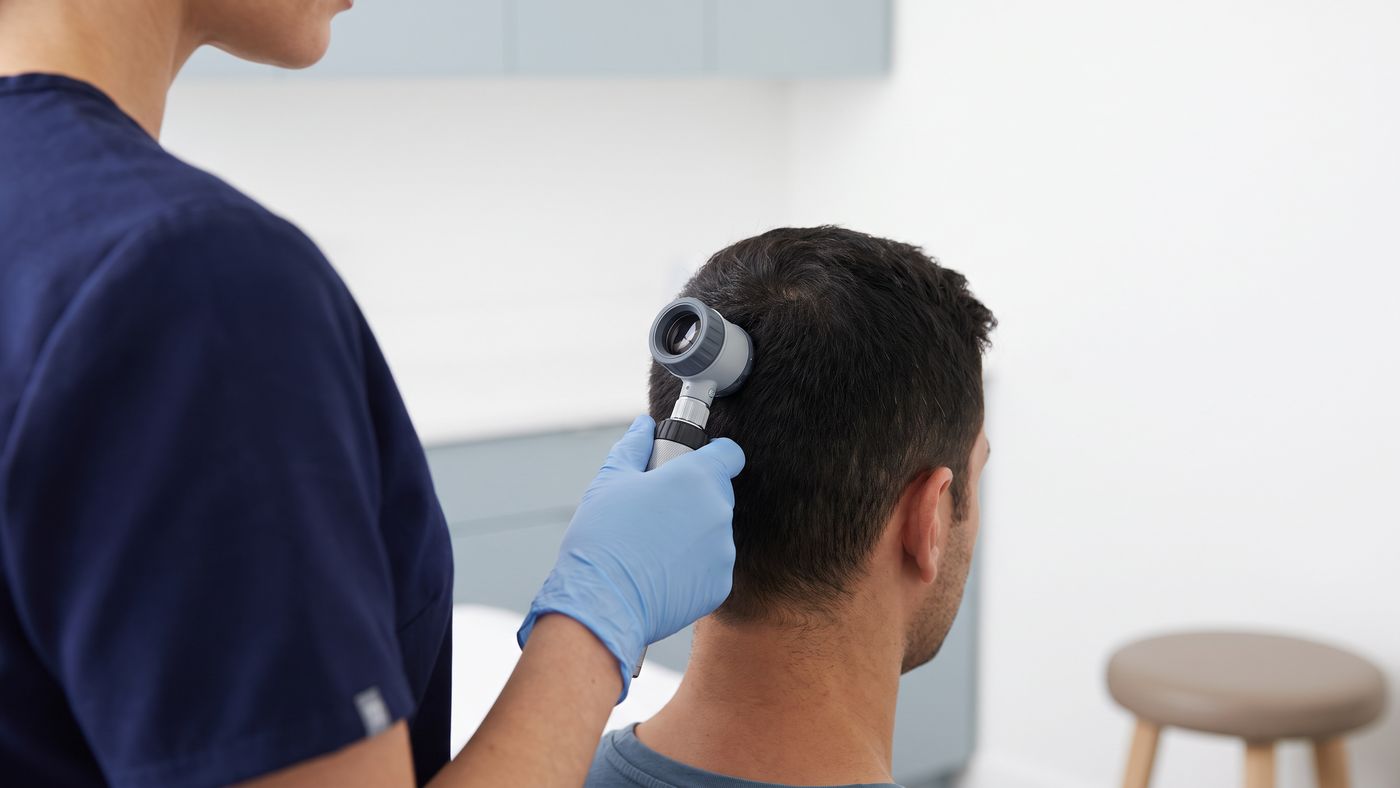
What gets checked
- Donor density: how many follicular units grow in each square centimeter, often measured under magnification
- Hairs per unit: the share of two- and three-hair groups, which multiplies coverage
- Hair caliber: thick shafts cover more scalp than fine ones
- Miniaturization at the back: thinning hairs in the donor zone can mean the permanent area is smaller than usual
- Safe zone boundaries: how high and how low extraction can go without harvesting hair that may be lost later
Why it changes your number
Surgeons extract only a fraction of the follicles in any zone and spread extractions evenly so the back never looks thin. If the donor area is dense and coarse, a large plan may be realistic in one session. If it is fine or shows miniaturization, the same goal may need a smaller first session, a more conservative hairline or medical therapy to protect existing hair. That is why your lifetime supply is a personal figure, not a fixed number.
What else changes your number
- Hair thickness: coarse hair covers more scalp per graft
- Curl: wavy and afro-textured hair creates more coverage
- Color contrast: low contrast between hair and skin looks denser
- Goals: a mature hairline needs fewer grafts than a teenage one
- Technique: Unshaven FUE may limit session size
How graft count affects cost
Per-graft clinics typically charge $4–$8 per graft, so a 3,000-graft session can exceed $15,000. Package pricing — popular in Turkey and used at HAIROCKET — sets one price for your planned session. See pricing or compare the three packages.
Get a personal estimate
Send four photos — front, top, crown and sides — and one of our Turkish-trained, Florida-licensed surgeons will estimate your graft count and plan within 24 hours. Learn about Sapphire FUE and unshaven FUE.
Step 1 of 6
- About you
- Pattern
- Areas & goal
- Your hair
- Donor area
- Estimate
About you
Your hair loss pattern
Not sure? Pick the closest — your surgeon confirms it from your photos.
Areas and goal
Your hair
Donor area and history
Your estimate is ready
Where should we send it? You'll see your graft range and recommended package right away — and a surgeon can confirm it in a free written plan.
Your estimated graft range
grafts
Recommended package:
An estimate from typical ranges — not a diagnosis. Your surgeon confirms the number after examining your donor area, free and in writing within 24 hours.
How many grafts for a hairline?
Restoring a receding hairline — the most common request — usually takes 1,500 to 2,500 grafts. The front edge uses single-hair grafts for softness; the zone behind uses two- and three-hair grafts for density. A lower, more youthful hairline needs more grafts and uses more of your lifetime donor supply, which is why surgeons often recommend a slightly more mature position.
How many grafts for the crown?
The crown is a large, round area where hair grows in a spiral. Covering it convincingly can take 1,500 to 3,000 grafts on its own. Because crown loss often progresses, many surgeons prioritize the hairline first and treat the crown later or with medical therapy.
One session or two?
If your plan exceeds what your donor area can safely provide in one day — or what can be implanted with high survival — your surgeon may recommend two sessions about a year apart. That allows the first session to mature and the donor area to recover.
| Plan | Typical approach |
|---|---|
| Up to ~3,500 grafts | Usually one session |
| 3,500–4,500 grafts | One session if the donor area allows |
| 4,500+ grafts | Often two sessions |
Planning for future loss: two illustrative examples
The same Norwood stage can lead to different plans depending on age and how stable the loss is. These examples are illustrative, not real patients.
| Topic | Example A | Example B |
|---|---|---|
| Profile | 27-year-old, Norwood 3, loss began in his early twenties, strong family history | 49-year-old, Norwood 3, pattern unchanged for many years |
| Likely plan | About 1,500–2,000 grafts focused on the hairline | About 2,000–2,500 grafts including the temples |
| Hairline position | Conservative, suited to his face in his forties and fifties | Can sit closer to his original position |
| Donor reserve | Kept deliberately large for future mid-scalp or crown loss | A smaller reserve is usually enough |
| Medical therapy | Usually recommended to slow ongoing loss | Discussed, but less critical |
Example A might want more grafts and a lower hairline now, but spending most of the donor supply at 27 leaves little for the loss that is likely to come. A plan that looks slightly modest today often looks better at 45. Our candidate guide explains how age and stability affect timing.
Density: what's realistic
Natural density on a full head of hair is often 80–100 follicular units per square centimeter. A transplant doesn't need to match that to look full — 40–50 grafts per square centimeter usually creates the appearance of density, especially with thicker or wavy hair. Your surgeon will show you what's realistic for your hair.
The math behind a graft estimate
Behind every answer to how many grafts you need is simple arithmetic: the size of the area to restore multiplied by the density the surgeon plans for it. The skill lies in choosing the area and the density.
- Map the zones: the surgeon outlines the hairline, frontal zone, mid-scalp and crown and estimates each area in square centimeters.
- Set a density per zone: the frontal zone usually gets the highest density because it frames the face; the crown often gets less.
- Multiply and add: area times grafts per square centimeter for each zone gives the total.
- Check against the donor: if the total exceeds what the donor area can safely give, zones or densities are scaled back.
| Illustrative zone | Area | Planned density | Grafts |
|---|---|---|---|
| Hairline and frontal zone | 40 cm² | 45 per cm² | 1,800 |
| Mid-scalp | 30 cm² | 35 per cm² | 1,050 |
| Total | 70 cm² | — | 2,850 |
These figures are illustrative, not a template; real areas are measured on your scalp. The logic shows why small design choices matter. Lowering a hairline by one centimeter across the full width of the forehead adds roughly a dozen square centimeters at frontal density, which can mean several hundred extra grafts.
How Turkish-trained surgeons plan graft counts
Surgeons who trained in Turkey's high-volume clinics are used to planning large sessions — and to saying no when the donor area can't support them. Our surgeons use donor density mapping and your hair characteristics to recommend a number that looks good now and leaves reserves for the future.
Mistakes to avoid when comparing graft counts
- Choosing the biggest number: a higher graft count is not a better plan if it spends donor hair you'll need later.
- Comparing hairs to grafts: convert every quote to grafts before you compare.
- Letting a package tier set the count: the number should come from a surgeon's assessment of your scalp, not from what a sales package includes.
- Forgetting the crown: if your crown is thinning, ask how the plan handles it now and in five years.
- Assuming unshaven means the same session size: unshaven FUE can limit how many grafts are practical in one day.
- Skipping medical therapy: a transplant moves hair; it does not stop ongoing loss around the new grafts.
A good plan explains its number: the zones, the density, the donor reserve and the reason for any second session. If a quote gives you only a total, ask for the reasoning behind it.
How to take photos for an accurate estimate
A remote estimate is only as good as the photos behind it. Hair that is styled, wet or lit from directly above can look thicker or thinner than it is, which can shift an estimate of how many grafts you need by hundreds.
blog-grafts-taking-scalp-photos-at-home.jpg · 16:9
- Use window daylight or even indoor light, not a single bright bulb overhead
- Photograph dry hair with no styling products, hair fibers or concealers
- Front: look straight at the camera with hair pushed back to show the whole hairline and temples
- Top: tilt your head down so the camera sees the mid-scalp from above
- Crown: ask someone to take it from directly above the back of your head, or use a timer and a mirror
- Sides: one photo of each side, plus the back if you can, to show the donor area
- Hold the camera at arm's length, keep it in focus and turn off filters and beauty modes
If your hair is long, an extra photo with it wet and combed flat helps the surgeon see the underlying pattern. Send your set through the free photo analysis and you'll receive a written plan within 24 hours.
Frequently asked questions
How many grafts is a normal hair transplant?
Most first sessions range from 1,500 to 3,500 grafts.
Can I get 5,000 grafts in one session?
Sometimes, with an exceptional donor area — but many surgeons split very large plans into two sessions.
How many hairs are in 2,000 grafts?
Usually 4,000–5,000 hairs, since grafts contain one to four hairs.
Do women need fewer grafts?
Often, because female plans usually add density rather than rebuild large areas.
Is 3,000 grafts a lot?
It's a common session size for moderate loss (Norwood 3–4).
How many grafts can my donor area provide?
Often 6,000–8,000 over a lifetime, depending on density and scalp size.

HAIROCKET editorial team
Written in South Florida from the questions patients ask most in consultations, and updated when techniques, prices or guidelines change. Read our editorial policy.