

Short on time? Summarize with AI
Open this article in your favorite AI assistant for an instant summary.
In this article
- Why Turkey has such a strong reputation
- The black-market problem
- How to verify a clinic in Turkey
- What a surgeon-led procedure day looks like
- Flying after a hair transplant
- Planning a safer trip, step by step
- The follow-up gap
- Bring your medical records home
- The alternative: Turkish expertise in the USA
- The real cost of a hair transplant in Turkey
- What complications look like — and how common they are
- Warning signs after you get home
- Questions to ask before booking any clinic
- Red flags in Turkish clinic marketing
Why Turkey has such a strong reputation
Turkey became the world's hair transplant capital by performing more procedures than anywhere else. That volume produced highly experienced surgeons and refined techniques like Sapphire FUE and DHI. For many patients, a hair transplant in Turkey has delivered excellent results at a lower headline price.
But reputation belongs to surgeons, not to a country. The same market that produced highly experienced clinics also attracted operators who cut corners.
The black-market problem
International hair restoration societies have warned for years about unlicensed clinics where technicians perform surgery with little or no physician involvement. Turkish health authorities have closed many illegal operations, but the scale of demand makes enforcement difficult.
- Technicians performing extractions and implantation
- Over-harvesting that permanently damages the donor area
- Poor sterility and infection risk
- Unnatural hairlines designed for maximum graft counts, not your face
Most bad outcomes share one feature: no qualified surgeon made the key decisions.
How to verify a clinic in Turkey
- Ask for the full name of the operating surgeon and look up their credentials
- Ask which steps the surgeon performs personally — in writing
- Request unedited before and after photos of patients like you
- Confirm the procedure happens in a licensed hospital or clinic
- Get a written plan with graft count, technique and price
- Understand what happens if you have a problem after you fly home
If a clinic can't name your surgeon or avoids the question of who operates, don't book.
What a surgeon-led procedure day looks like
Clinics describe their process in similar words, so it helps to know what a properly run day actually involves. The question is not whether technicians are present, since every clinic relies on a trained team, but which decisions stay with the surgeon.
blog-turkey-safe-surgeon-hairline-design.jpg · 16:9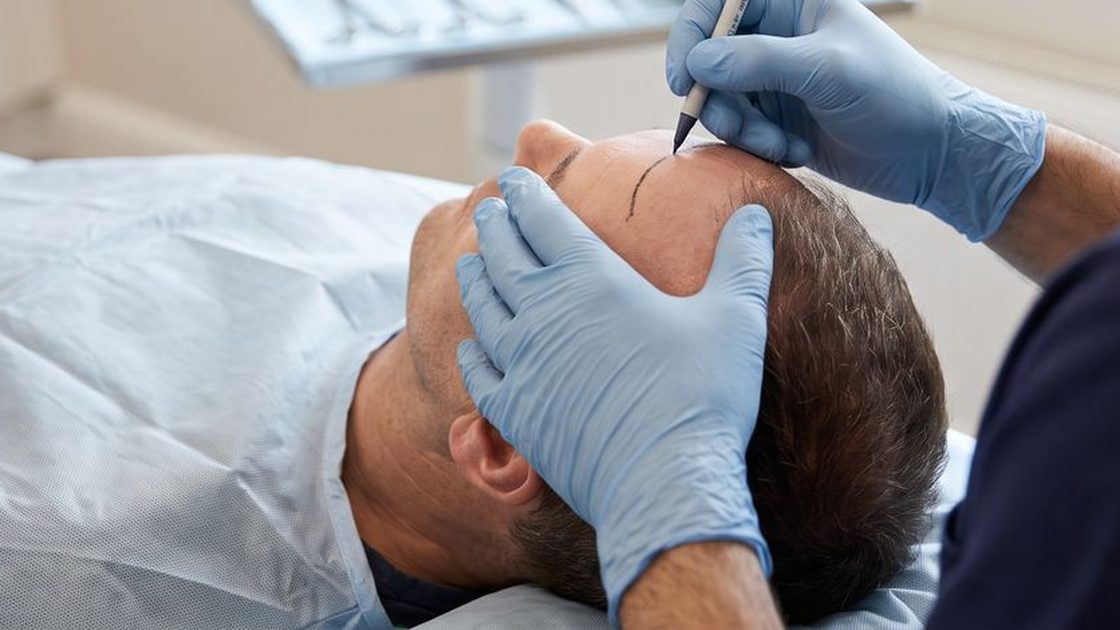
| Step | Surgeon-led clinic | Technician-run volume clinic |
|---|---|---|
| Hairline design | Drawn by the surgeon with you, in front of a mirror | Pre-set template or drawn by a coordinator |
| Donor planning | Surgeon maps how many grafts each zone can safely give | Target graft count set by the package that was sold |
| Extraction | Performed or directly supervised by the surgeon | Technicians work with little physician oversight |
| Recipient channels | Opened by the surgeon, who sets angle, direction and density | Often opened by technicians |
| Patients per team | One, or a small number, per day | Several patients in parallel |
| Graft handling | Grafts kept chilled, counted and sorted by hair number | Grafts may sit outside the body for long periods |
Ask the clinic to walk you through its day in this order. A clinic that is confident in its process will answer each step without hesitation and put the answers in writing.
Hairline design and recipient channel creation shape how natural your result looks. They should be done by a physician, not delegated.
Flying after a hair transplant
Most Turkish packages schedule your flight home two to four days after surgery. Long-haul flights of 10–12 hours are generally considered safe, but they're uncomfortable with a fresh recipient area: swelling can increase, you can't rest your head naturally and your first washes happen in a hotel. Plan an aisle seat, a travel pillow that avoids the grafts and plenty of water.
Planning a safer trip, step by step
Most problems with a hair transplant in Turkey are avoidable with planning done weeks before you leave. This timeline assumes a typical package of three to five nights.
blog-turkey-safe-trip-planning-documents.jpg · 16:9
| When | What to do |
|---|---|
| 4–6 weeks before | Get the surgeon's name, a written plan and a written quote; share your full medical history and medication list |
| 2 weeks before | Ask the surgeon which supplements and medications to pause; never stop a prescribed medication without your own doctor's advice |
| Travel day | Arrive rested and avoid alcohol on the flight and the night before surgery |
| Procedure day | Confirm in person who your surgeon is and that the hairline is drawn with you before anything else |
| Day 1–2 | Attend the first wash and check at the clinic and ask for written washing instructions |
| Flight home | Wear a loose button-up shirt, keep any pillow away from the grafts and skip tight caps |
| First 2 weeks home | Follow the washing routine, sleep semi-upright for the first nights and photograph your scalp every few days |
Pack printed copies of your plan and the clinic's emergency contact. If your phone is lost or your connection drops, you still have what a local doctor would need to help you.
The follow-up gap
The hardest part of a hair transplant abroad isn't the surgery — it's the next twelve months. Questions about redness, shedding and slow growth are common, and answers come by photo and message from a clinic eight time zones away. If you need to be seen in person, that means another international trip.
Bring your medical records home
If you choose a hair transplant in Turkey, the most useful thing you can carry home is documentation. A U.S. doctor who sees you for a complication or a second opinion will ask for details that only the operating clinic has.
- Operative report: date, technique, the surgeon's name and who performed each step
- Graft count by type: how many one-, two-, three- and four-hair grafts were placed
- Donor map: which zones were harvested and roughly how many grafts came from each
- Medications: everything prescribed, with doses and duration
- Day-of-surgery photos: donor and recipient areas immediately after the procedure
- Direct medical contact: a doctor or nurse, not only a sales coordinator
Example: a worrying moment at week six
Example: a 35-year-old returns home after a 3,000-graft session abroad. At week six most of the transplanted hairs have shed and the hairline looks thinner than it did before surgery. This is usually normal shedding and shock loss, but without records a local doctor cannot tell how many grafts were placed or whether the donor area was over-harvested. With records and photos, the same visit becomes a quick, reassuring check.
The alternative: Turkish expertise in the USA
If you want the Turkish approach without the travel risk, look for a Turkish-trained surgeon licensed in your state. At HAIROCKET, our surgeons trained in high-volume Turkish clinics and now operate in South Florida under Florida licensure, with in-person follow-up. Read our full Turkey vs USA comparison or learn about a Turkish hair transplant in the USA.
The real cost of a hair transplant in Turkey
A Turkish package is usually advertised at $2,500 to $3,500 and includes the procedure, hotel and transfers. For an American patient, the real total also includes round-trip flights ($1,000–$1,800), a companion's travel if you bring one, extra hotel nights, a week away from work and any follow-up trips. Many patients end up spending $6,000 to $8,500 — before any corrective work.
That doesn't make Turkey a bad choice. It means the comparison should be total cost and total risk, not the headline package price.
What complications look like — and how common they are
Serious complications after a hair transplant are uncommon when a qualified surgeon operates. The most frequent problems are poor growth, an unnatural hairline, visible donor thinning from over-harvesting and, less often, infection. Most of these trace back to planning decisions — how many grafts to take, where to place them and how deep — which is why the surgeon's role matters so much.
- Poor growth: often from grafts kept out of the body too long or damaged during handling
- Unnatural hairline: too low, too straight or wrong angles
- Donor depletion: too many grafts taken from one area
- Infection: rare with proper sterility and aftercare
Warning signs after you get home
Some changes after surgery are expected, and a few need prompt attention from a doctor near you. Knowing which is which saves needless worry and avoids delaying care when it matters.
| Area | Usually expected | Needs prompt attention |
|---|---|---|
| Recipient area | Redness, small crusts for about a week to ten days, mild itching | Spreading redness, yellow discharge, crusts that keep growing |
| Swelling | Forehead swelling in the first few days, sometimes reaching the eyes | Swelling that worsens after the first week |
| Discomfort | Soreness and tightness that eases with prescribed medication | Pain that increases after day three instead of easing |
| General | Tiredness for a day or two | Fever or chills |
| Months 1–4 | Shedding of transplanted hairs; occasional pimple-like bumps as new hairs break through | Many painful, swollen bumps, or bumps that keep returning |
| Donor area | Tiny pink dots and temporary numbness | Visible patches or thinning that persist after healing |
If you are unsure, send clear photos to your operating clinic the same day. For anything in the right-hand column, see a local doctor as well: waiting for a reply across time zones should not delay care for a possible infection. If you live in South Florida, our clinic in Tamarac can assess you in person.
Questions to ask before booking any clinic
- What is the surgeon's full name, and where can I verify their license?
- Will the surgeon design my hairline in person?
- Which steps will the surgeon perform, and which will technicians perform?
- How many procedures does the clinic perform on the same day?
- What exactly is included in the price?
- What is your policy if growth is poor at 12 months?
- How will follow-up work once I'm home in the U.S.?
Write the answers down. Vague answers are an answer in themselves.
Red flags in Turkish clinic marketing
Aggressive discounts that expire today, promises of unlimited or "guaranteed" graft counts, before-and-after photos without consistent lighting and angles, and a sales coordinator who answers every medical question are all warning signs. So is a clinic that performs many surgeries at once with one doctor listed for all of them.
Frequently asked questions
Is it safe to get a hair transplant in Turkey?
It can be, with a verified, surgeon-led clinic. The main risk is unlicensed operations where technicians perform surgery.
How do I know if a Turkish clinic is legitimate?
Verify the operating surgeon's name and credentials, get a written plan, and confirm the procedure takes place in a licensed facility.
Can I fly home the day after a hair transplant?
Short flights are usually fine; long-haul flights are best delayed at least two to three days.
What if something goes wrong after I return to the U.S.?
You'll need to rely on remote follow-up or find a local specialist. We see patients after procedures abroad.
Do Turkish clinics use licensed doctors?
Reputable ones do. Always verify the operating surgeon's name and credentials before booking.
Is a hair transplant cheaper in Turkey including travel?
Often still cheaper, but the gap narrows significantly once flights, hotels and time off are included.

HAIROCKET editorial team
Written in South Florida from the questions patients ask most in consultations, and updated when techniques, prices or guidelines change. Read our editorial policy.