

Short on time? Summarize with AI
Open this article in your favorite AI assistant for an instant summary.
In this article
- What shock loss is
- The hair growth cycle behind shock loss
- When it happens and how long it lasts
- Shock loss of native hair
- Who is more likely to notice it
- Can shock loss be reduced?
- Mistakes that make the shedding phase harder
- What to do during the shedding phase
- How to track regrowth with photos
- When shedding is not normal
- An illustrative recovery, month by month
- Why patience pays
What shock loss is
Surgery is a stress on the scalp. In response, some hair follicles move into a resting phase and release the hair shaft. The follicle itself remains alive under the skin and, after a few months, starts a new growth cycle.
Patients use "shock loss" for two related things: the expected shedding of the newly transplanted hairs, and temporary shedding of existing hair around the recipient area or in the donor area. Both usually have the same explanation and the same outcome.
The hair growth cycle behind shock loss
Shock loss makes more sense once you know that every follicle cycles through phases. Each follicle runs its own cycle, which is why you never lose all your hair at once.
blog-shock-loss-shed-hairs-comb.jpg · 16:9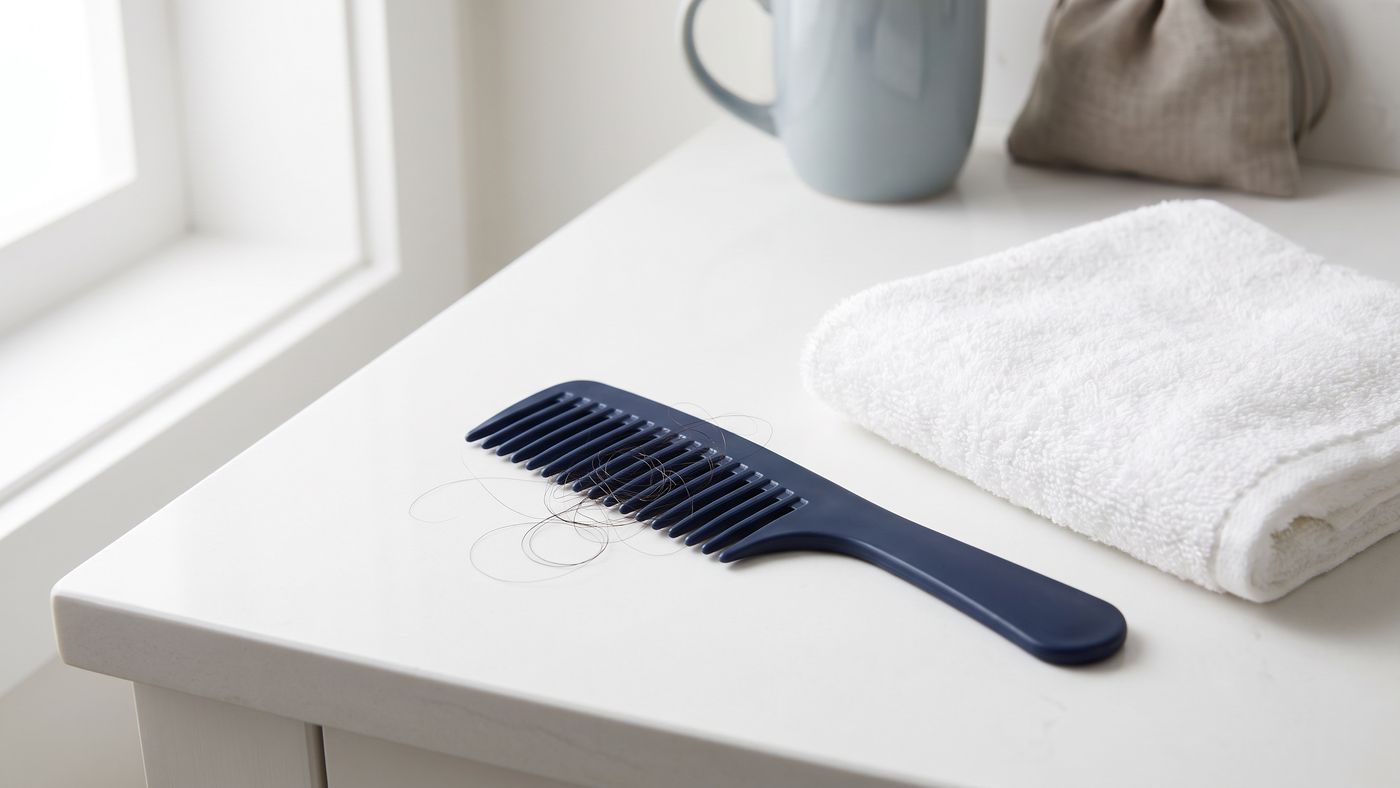
| Phase | What the follicle does | Typical length |
|---|---|---|
| Anagen (growth) | Actively produces hair | Several years on the scalp |
| Catagen (transition) | Growth stops, follicle shrinks slightly | A few weeks |
| Telogen (resting) | Hair is held in place, then released | Around three months |
| New anagen | A new hair starts growing from the same follicle | The cycle begins again |
Surgery can push many follicles into the resting phase at the same time. Instead of a few hairs shedding here and there, a larger group releases its hair over the same few weeks. That timing is what makes shock loss noticeable.
It also explains the recovery pattern. Resting follicles typically wait around three months before growing again, which lines up with new hair appearing around months three to four. The first new hairs are fine and short; they thicken as they mature over the following months.
Three kinds of shedding, side by side
| Topic | Transplanted hair shedding | Native shock loss | Everyday shedding |
|---|---|---|---|
| Where | The grafted area | Around the grafts or in the donor area | Anywhere on the scalp |
| Expected? | Yes, in most patients | Sometimes; varies by person | Yes, always |
| Usually regrows? | Yes, from months 3–4 | Usually, if the hair was healthy | Yes, continuously |
When it happens and how long it lasts
| Time after surgery | What you may notice |
|---|---|
| Weeks 1–2 | Small crusts fall off; short hair shafts stay in place |
| Weeks 2–8 | Transplanted hairs shed; some native hair may thin |
| Months 3–4 | New, fine hairs start to appear |
| Months 6–9 | Hair thickens and grows longer |
| Month 12 (crown up to 18) | Final density and texture |
Everyone's timing differs slightly. See the full day-by-day recovery timeline for what to do at each stage.
Shock loss of native hair
Native hair that is already thinning — miniaturized by pattern hair loss — is the most sensitive. Healthy native hair that sheds usually returns within three to four months. Hair that was already very weak may not come back, which is one reason surgeons plan the design around your long-term pattern rather than today's hairline.
Donor-area shedding is less common and usually mild. It grows back over the same period and is hidden by longer hair around it.
Who is more likely to notice it
Anyone can shed after surgery, but some situations make native shock loss more likely or more visible. Knowing this ahead of time helps you set expectations with your surgeon.
- Grafts placed between existing hairs. When a thinning area still has native hair, channels are opened close to it, and that hair is under more stress than hair in a fully bald zone.
- Many miniaturized hairs in the recipient area. Weak, thin hairs are the most sensitive, and some may not return.
- Diffuse thinning, which is common in women. Transplants into areas with a lot of native hair may lead to more noticeable temporary shedding — see female hair loss and transplants.
- Unshaven procedures. Keeping native hair long hides the work on day one, but temporary shedding of that hair can still occur in the following weeks — see unshaven FUE.
- Donor-area extraction. A little temporary thinning between extraction sites is possible, usually hidden by the surrounding hair.
None of these factors mean shock loss is certain. They are the reasons a surgeon asks about your hair history and may discuss medical therapy to protect native hair before and after the procedure.
Can shock loss be reduced?
No method prevents it completely, but several steps can help:
- Careful surgical technique, with channels opened between existing hairs rather than through them
- Medical therapy to protect native hair, if your doctor recommends it — see PRP vs hair transplant
- Following the aftercare instructions for washing, sleeping and sun exposure
- Not smoking around the time of surgery, which supports healing
Do not start, stop or change any medication after surgery without talking to your surgeon.
Mistakes that make the shedding phase harder
Most of what goes wrong with shock loss after a hair transplant is not medical. It is anxious decision-making at the point where the result looks its worst.
- Judging the result at month two. This is the lowest point of the timeline. Hold your assessment until at least month six, and the final one until month twelve.
- Adding new products on impulse. New topicals, oils or supplements can irritate a healing scalp or interact with your plan. Ask your clinic first.
- Washing too aggressively — or not at all. Scrubbing can disturb healing grafts early on, while skipping washes leaves crusts in place longer. Follow the washing steps you were given.
- Coloring or chemically treating hair too early. Dyes and relaxers should wait until your surgeon clears you.
- Comparing your timeline with someone else's. Growth varies between people and between areas; the crown is often slower than the front.
- Skipping the month-three check. It is when your surgeon can confirm that new growth is starting as expected.
What to do during the shedding phase
- Keep washing gently as instructed — shed hairs in the sink are expected, not a sign of damage
- Avoid picking at the scalp or pulling out hairs that seem loose
- Protect the scalp from strong sun with a loose hat until your surgeon says otherwise
- Keep your follow-up appointments, in person or by video, so your surgeon can check progress
- Style for comfort: a slightly longer cut on the sides or a light hair fiber product, once cleared by your clinic, can help in social situations
How to track regrowth with photos
The mirror is a poor judge during recovery because you see yourself every day. A simple photo routine gives you — and your surgeon — a clear record.
blog-shock-loss-progress-photos.jpg · 16:9
Set up once
- Pick one spot with steady light, ideally the same room at the same time of day
- Take the same four views each time: front, top, crown and both sides
- Keep hair dry and styled the same way, without fibers or products
- Use a phone on a shelf or a timer to keep the distance consistent
What to look for at each checkpoint
| Checkpoint | Typical picture | Worth mentioning to your clinic |
|---|---|---|
| Month 1 | Short shafts shedding; scalp healing | Any lasting redness or tenderness |
| Month 3 | First fine hairs; still sparse | No visible change at all in the grafted area |
| Month 6 | Clear growth; hair still fine in places | Areas that look much weaker than others |
| Month 9 | Thicker, longer hair | Native hair that has not returned |
| Month 12 | Near-final density at the front | Anything you want reviewed before the final check |
These checkpoints match HAIROCKET's follow-ups at months 3, 6, 9 and 12, so bring or send your photos to each one. The patient guide covers the aftercare steps in more detail.
When shedding is not normal
Shedding on its own is expected. These signs are not, and deserve a call the same day:
- Increasing pain, swelling or warmth after the first few days
- Spreading redness, pus or a bad smell from the scalp
- Fever or feeling unwell
- Patchy, round bald spots appearing far from the treated area
At HAIROCKET, patients can send photos to their care team at any stage and are seen in person by a Florida-licensed surgeon when something needs a closer look.
An illustrative recovery, month by month
Example only, not a real patient: a 42-year-old with Norwood 3 recession and some thinning native hair behind the hairline has a Sapphire FUE procedure to rebuild the front.
- Week 1: Small crusts form and fall away after gentle washing. The new hairline is visible as short stubble.
- Weeks 3–6: Most of the transplanted hairs shed. Some of the thinning native hair just behind the hairline sheds too, so the front looks thinner than before surgery.
- Month 3: At the follow-up, the surgeon sees fine new hairs emerging along the hairline and reassures him that the native area should start to recover as well.
- Month 6: The hairline is clearly growing and most of the shed native hair has returned. A few of the weakest native hairs have not.
- Months 9–12: Hair thickens and gains length. By the final check, the front is fuller than before surgery, and the plan shifts to protecting native hair over the long term.
Two points stand out. The worst-looking weeks came well before the first new growth, and the few native hairs that did not return were ones that were already very weak. Both are common features of recovery, and both are easier to accept when you know about them in advance.
If you want a realistic plan for your own pattern, a free photo analysis is the place to start — see am I a good candidate.
Why patience pays
Months two and three are often the hardest emotionally: the grafts have shed, the new hair is not visible yet and the result can look worse than before surgery. This "ugly duckling" stage is temporary. Taking monthly photos in the same light helps you see progress that is hard to notice in the mirror.
If you are still planning surgery, ask any clinic how it handles follow-up during these months and who you can call. It matters as much as the procedure itself — compare options in Turkey vs USA.
Frequently asked questions
Is shock loss after a hair transplant permanent?
Usually not. Most shed hair regrows within three to four months. Hair that was already very miniaturized may not return.
When does shock loss start?
Most often between the second and eighth week after surgery.
Does shock loss mean the grafts failed?
No. Shedding of the hair shaft is expected; the follicle stays in the scalp and starts growing again.
Can shock loss happen in the donor area?
Yes, occasionally. It is usually mild and grows back over a few months.
How can I tell shedding from infection?
Shedding is painless. Increasing pain, spreading redness, pus or fever point to a problem — call your surgeon.

HAIROCKET editorial team
Written in South Florida from the questions patients ask most in consultations, and updated when techniques, prices or guidelines change. Read our editorial policy.