

Short on time? Summarize with AI
Open this article in your favorite AI assistant for an instant summary.
In this article
- 1. Donor supply
- 2. Stability of your hair loss
- 3. Age
- 4. Hair characteristics
- How your pattern of hair loss affects candidacy
- 5. General health and diagnosis
- Medications, smoking and scalp conditions
- 6. Realistic expectations
- Three illustrative scenarios
- How to prepare for your assessment
- A quick self-check before you book
- If you are not a good candidate yet
- Common mistakes when deciding
1. Donor supply
Transplanted hair comes from the back and sides of the head. The number of follicles there, and how dense they are, sets a lifetime budget. A surgeon estimates how many grafts can be taken safely without visibly thinning the donor area — and keeps some in reserve in case hair loss progresses. See how many grafts you need for typical numbers by Norwood stage.
2. Stability of your hair loss
If hair loss is still progressing quickly, a new hairline can end up isolated in front of thinning hair behind it. Surgeons look at how your pattern has changed over the past year or two and often recommend medical therapy first to slow it down.
3. Age
There is no strict minimum age, but most surgeons are cautious under about 25, when the final pattern is hard to predict. That does not mean waiting without doing anything: medical therapy or PRP can help protect native hair while the picture becomes clearer.
4. Hair characteristics
- Thickness: thicker hair covers more scalp per graft
- Curl: curly and afro-textured hair can look fuller, but needs a surgeon experienced with curved follicles
- Color contrast: low contrast between hair and skin makes density look higher
- Donor density: more follicles per square centimeter means more options
How your pattern of hair loss affects candidacy
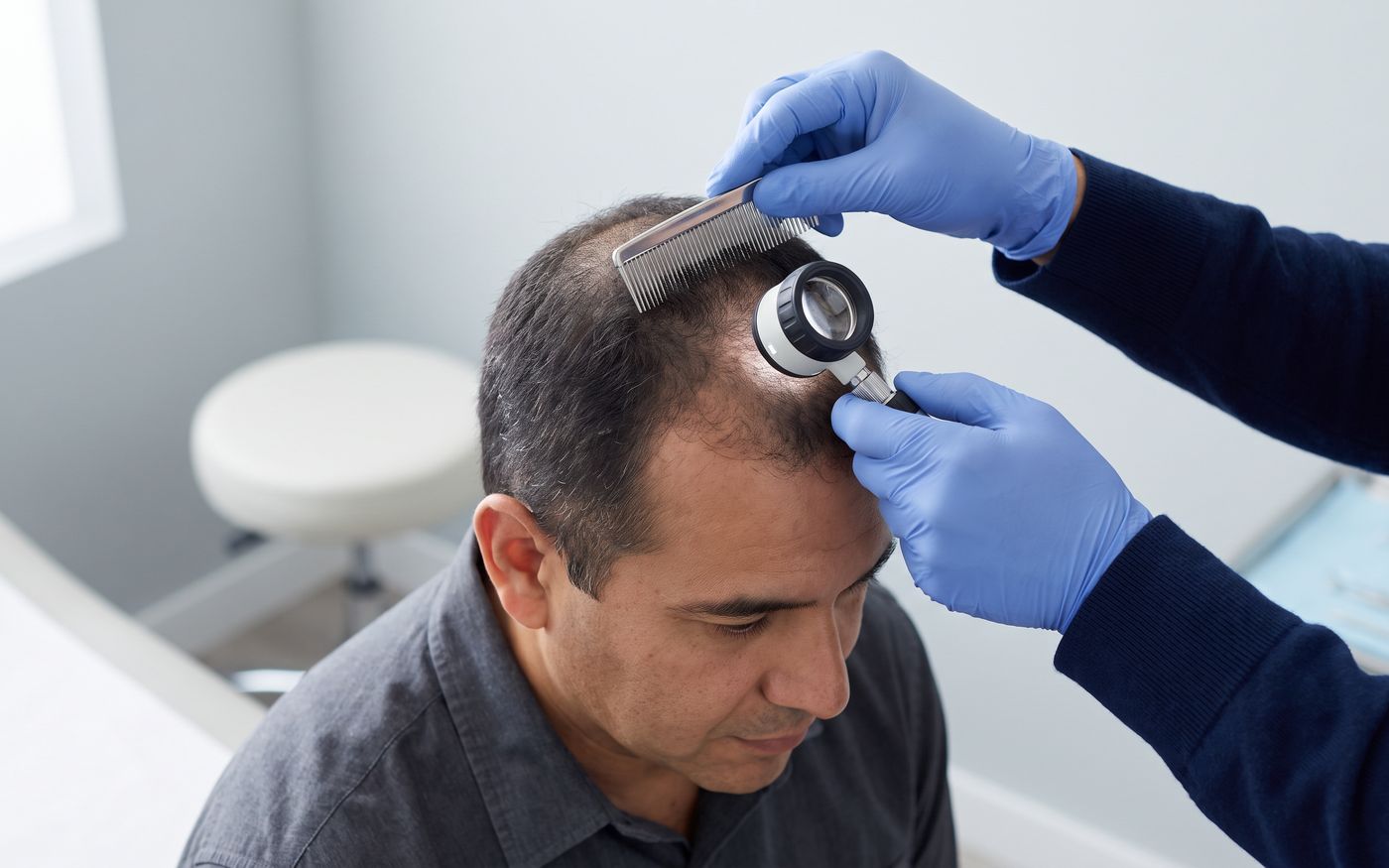
Surgeons describe male pattern loss with the Norwood scale and female pattern loss with the Ludwig or Savin scales. Your stage does not decide candidacy on its own, but it tells the surgeon how much area needs covering compared with how much donor hair you have.
blog-candidate-consultation-review.jpg · 16:9
| Pattern | Typical outlook | What the surgeon weighs |
|---|---|---|
| Early recession (Norwood 2) | Often better to wait or treat medically | Whether the change is still progressing and how young you are |
| Temple and frontal loss (Norwood 3) | Often a strong candidate | A mature hairline that will still suit you in twenty years |
| Frontal loss plus crown thinning (Norwood 4–5) | Usually a candidate with prioritized goals | Front first; the crown may need a later session |
| Advanced loss (Norwood 6–7) | Possible when donor supply allows | Coverage versus density; frontal framing over full coverage |
| Diffuse thinning without a stable edge | Often better treated medically first | Whether the cause is pattern loss or something else |
The crown deserves a special mention. It is a large, round area where hair grows in a whorl, so it takes many grafts to look dense and can keep expanding with age. Many surgeons restore the front first and treat the crown later, once they see how it develops. Read more on crown restoration, or get a rough number from the graft calculator.
5. General health and diagnosis
A transplant is minor surgery under local anesthesia, but health still matters. Bleeding disorders, some heart conditions and poorly controlled diabetes need medical clearance. Just as important is the diagnosis: pattern hair loss responds well to a transplant, while active alopecia areata or some scarring conditions are usually treated differently or need to be stable for a long time first.
Women's hair loss has more possible causes, so a medical work-up comes first — read female hair loss.
Medications, smoking and scalp conditions
Beyond the diagnosis, a few everyday factors change how safely surgery can be done and how well grafts heal. None of them automatically rules you out, but each needs to be discussed openly.
Blood thinners and supplements
Aspirin, prescription anticoagulants and some supplements, such as fish oil, vitamin E or ginkgo, can increase bleeding. Your surgeon and the doctor who prescribed a medication decide together whether anything should be paused before surgery, and for how long. Never stop a prescribed medication on your own.
Smoking and nicotine
Nicotine narrows small blood vessels, and new grafts depend on a good blood supply in the first days. Surgeons commonly ask patients to stop smoking and vaping for a period before and after the procedure. The exact window is part of your written instructions.
Scalp conditions
Seborrheic dermatitis, psoriasis or folliculitis on the scalp are usually brought under control before surgery so that the skin heals cleanly. Tell your surgeon about any flare-ups, even mild ones.
Existing hair-loss treatment
If you already use a hair-loss medication that works for you, surgeons usually prefer that you keep using it around the procedure unless they advise otherwise, because it helps protect the native hair around the new grafts.
6. Realistic expectations
A transplant redistributes existing hair; it does not create new follicles. A good result looks natural and fits your age and face, which is not always the same as the density you had at eighteen. Good candidates understand the timeline — final results around month twelve — and the possibility of a future session if loss continues.
Three illustrative scenarios
The examples below are illustrative only, not real patients. They show how the same six factors can lead to very different recommendations.
Example: 23, early recession, changing fast
A 23-year-old notices his temples moving back quickly over the past year, and his father went very bald. His donor area is good, but his final pattern is unknown. A careful surgeon would likely recommend medical therapy and a reassessment in twelve months, rather than a low hairline that could look out of place later.
Example: 44, Norwood 5, stable for years
A 44-year-old has had the same pattern for several years and a dense donor area. He is usually a good candidate for a hair transplant, with a plan that rebuilds a mature hairline and frontal zone first and keeps grafts in reserve for the crown.
Example: 36, diffuse thinning on top
A 36-year-old woman sees her part widening, with no clear receding edge. The first step is a medical work-up, since thyroid problems, iron deficiency or hormonal changes can play a role. If the cause is female pattern loss and the donor area is stable, a focused transplant to the part line may become an option later. See female hair transplant.
How to prepare for your assessment
You get a more accurate answer when the surgeon has the full picture. Before a consultation or photo analysis, it helps to gather:
- Clear photos of the front, top, crown, both sides and the back, in good light with dry hair
- A few older photos showing how your hairline has changed over the years
- Your family history of hair loss on both sides
- A list of medications and any hair-loss treatments you have tried, and for how long
- Any previous hair transplant details, if you have had one
A quick self-check before you book
You cannot diagnose yourself, but you can get a sense of where you stand before a consultation. The more of these statements are true for you, the more likely a surgeon is to recommend surgery now rather than later.
blog-candidate-self-check-at-home.jpg · 16:9
- My hair loss has looked about the same for at least a year, or I have been on a treatment that slowed it
- The back and sides of my head still look full when my hair is cut short
- I have a diagnosis, or at least a clear pattern of loss at the temples, front or crown
- I am generally healthy, or my conditions are well controlled
- I can plan a few quiet days after surgery and a full year before judging the result
- I am looking for a natural result that suits my age, not the hairline I had as a teenager
- I understand I may need medical therapy, or a second session, to maintain the result over time
If several answers are "no" or "not sure", that is a reason to ask more questions, not to rule yourself out. A surgeon can often tell from good photos whether the gaps matter in your case.
If you are not a good candidate yet
Being told "not yet" is useful information. Common next steps are medical therapy, PRP, a lower-density plan that preserves donor hair, or simply reassessing in a year. A clinic that recommends surgery to everyone is a red flag.
The fastest way to know where you stand is a free photo analysis: a Turkish-trained, Florida-licensed surgeon reviews your pattern and donor area and tells you honestly whether surgery makes sense now, with a written quote if it does. Techniques are explained on our Sapphire FUE page.
Common mistakes when deciding
Most disappointing results come from decisions made before the procedure, not from the surgery itself. These are the mistakes surgeons see most often.
- Designing for today only. A very low, straight hairline may look good at 28 and odd at 50, once the hair behind it has thinned.
- Spending the donor budget too early. Using a large number of grafts on a small area leaves fewer for later needs, such as the crown.
- Skipping medical therapy. A transplant does not stop native hair from thinning; without maintenance, gaps can appear around the new grafts.
- Choosing on price per graft alone. A lower headline price can hide limits on grafts, extra fees or less experienced teams. Compare what is included, as explained in the cost guide.
- Leaving out medical history. Medications, past surgery and scalp conditions change the plan; hiding them only raises the risk.
- Judging too early. Transplanted hair sheds in the first weeks and grows slowly; a verdict at month four says little about month twelve.
A good consultation should cover each of these points. If yours does not, ask.
Frequently asked questions
What is the best age for a hair transplant?
There is no single best age. Most surgeons prefer a stable pattern, which often means waiting until the mid-twenties or later.
Can I get a hair transplant if I am completely bald?
It depends on your donor area. With very limited donor hair, coverage is limited and expectations need to be adjusted.
Can women be good candidates?
Yes, when the cause is identified and the donor area is stable. Diffuse thinning often responds better to medical treatment.
Do I need to stop medications before surgery?
Some medications, such as blood thinners, may need changes. Never stop a medication without your doctor's advice.
How do I find out if I am a candidate?
Send photos for a free analysis; a surgeon reviews your pattern, donor area and history, then recommends a plan.

HAIROCKET editorial team
Written in South Florida from the questions patients ask most in consultations, and updated when techniques, prices or guidelines change. Read our editorial policy.