
Short on time? Summarize with AI
Open this article in your favorite AI assistant for an instant summary.
In this article
- How each technique works
- What both techniques share: the extraction step
- Implantation in detail: channels vs. implanter pens
- Side-by-side comparison
- Which should you choose?
- Three illustrative scenarios
- Why both are associated with Turkey
- What results to expect
- Combining Sapphire FUE and DHI
- Who is a good candidate for each?
- How hair type influences the technique
- Recovery compared
- What the procedure day feels like
- Cost compared
- Common myths
- Beyond the label: what actually decides your result
- How your surgeon decides
How each technique works
Sapphire FUE
Grafts are extracted individually, then the surgeon opens recipient channels with ultra-fine sapphire blades before placing grafts. The V-shaped incisions are smaller and smoother than steel-blade channels, allowing tighter, denser placement.
DHI
Grafts are loaded into a Choi implanter pen and placed directly, creating the channel and implanting in one motion. The surgeon controls angle, depth and direction for every graft.
What both techniques share: the extraction step
The Sapphire FUE vs DHI debate is really about the second half of the procedure. The first half, harvesting grafts from the donor area, is essentially the same for both.
- Preparation: the donor area at the back and sides is trimmed short, and the surgeon marks the safe extraction zone.
- Local anesthesia: the donor area is numbed before any extraction begins.
- Extraction: a micro-punch, typically under about one millimeter wide, frees each follicular unit, which is then gently removed.
- Sorting and storage: grafts are counted, sorted by number of hairs and kept in a chilled holding solution until implantation.
Because extraction is the same, donor healing is the same too. Any difference in how the donor area looks afterward comes from how many grafts are taken and how evenly they are spread, which are decisions made by the surgeon rather than by the implantation method.
Implantation in detail: channels vs. implanter pens
Sapphire FUE: design first, then place
The surgeon opens every recipient channel before any graft is placed. This is where the design is set: the angle each hair will grow at, its direction and how closely channels sit together. Sapphire blades come in precise widths, so channel size can be matched to graft size. Once the map is complete, the team places grafts into the channels with fine forceps.
DHI: create and place in one motion
In DHI, each graft is loaded into the hollow needle of an implanter pen. The surgeon inserts the needle at the chosen angle and depth and releases the graft as the channel is created. Assistants reload several pens in rotation so the surgeon can keep working. Because every graft is a separate implantation step, large plans take longer.
| Variable | Sapphire FUE | DHI |
|---|---|---|
| When angle and direction are set | When channels are opened, before placement | At the moment each graft is implanted |
| Instrument at the recipient site | Sapphire blade, then forceps | Implanter pen with a hollow needle |
| Graft handling | Placed into ready channels | Loaded into a needle, then implanted |
| Pace over large areas | Efficient, since the map is set once | Slower, one graft at a time |
| Recipient-area shaving | Usually needed | Can often be limited |
Neither method is gentler by default. Graft survival depends on careful handling, short time outside the body and a team that is well trained with the instrument it uses.
blog-sapphire-fue-blade-and-grafts.jpg · 16:9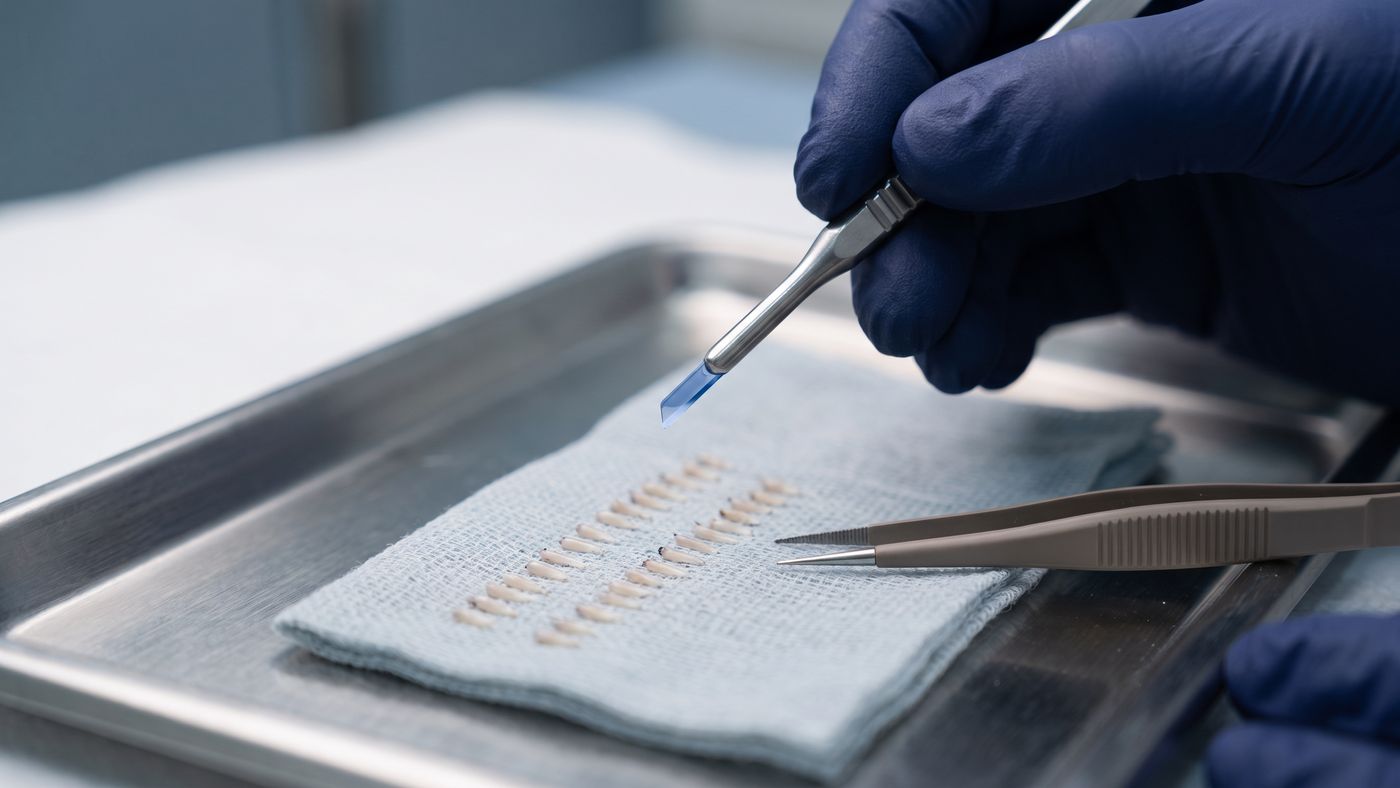
Side-by-side comparison
| Topic | Sapphire FUE | DHI |
|---|---|---|
| Best for | Density, larger areas | Hairline detail |
| Implantation | Pre-made sapphire channels | Direct with Choi pen |
| Shaving | Usually required | Partial possible |
| Session size | Up to ~4,000 grafts | Up to ~3,000 grafts |
| Healing | Fast | Fast |
| Relative cost | Standard | Slightly higher |
Which should you choose?
Choose Sapphire FUE if you need coverage across the hairline, mid-scalp and crown. Choose DHI if your priority is a precise, natural hairline or you want to avoid shaving the whole recipient area. Some patients benefit from both: DHI for the front edge and Sapphire FUE for density behind it.
Three illustrative scenarios
These examples are illustrative, not real patients. They show how the size of the area and personal priorities shape the choice.
Example 1: early temple recession, longer hair
A 29-year-old with Norwood 2 recession wants his temples softened and does not want to shave his longer hair. The area is small, so either DHI or an unshaven FUE approach could work. The deciding questions are whether he can accept trimmed donor strips hidden under longer hair and whether the clinic's method keeps the top unshaven. At HAIROCKET, this would be planned as unshaven FUE, a separately priced add-on.
Example 2: hairline and crown
A 45-year-old at Norwood 4 needs about 3,000 grafts across the hairline, mid-scalp and crown. Sapphire FUE suits this plan because the channel map can be designed for the whole area at once and the session stays efficient. DHI is possible at some clinics but usually takes longer for the same graft count. See how the crown is approached in crown restoration.
Example 3: thinning behind a stable hairline
A 38-year-old woman has diffuse thinning along her part but a stable frontal hairline, and her priority is avoiding a visible shave. Placing grafts between existing hairs requires precise sites that avoid damaging native follicles, which experienced surgeons can achieve with either method. The bigger question is whether she is a candidate at all; our guide to female hair loss and transplants covers that.
Why both are associated with Turkey
Turkish clinics refined both techniques through enormous volumes. Our surgeons trained in that environment; at our clinic in Tamarac, near Fort Lauderdale, they perform Sapphire FUE (DHI is not offered) — see Turkish hair transplant in the USA.
What results to expect
With either technique, new growth appears around month three to four, visible change by month six and the final result around month twelve. Graft survival depends more on the surgeon and team than on the technique name.
Combining Sapphire FUE and DHI
Some clinics use both techniques in one session. DHI places the first rows of the hairline with maximum control over angle and direction; Sapphire FUE then builds density behind it efficiently. This combination — common in high-volume Turkish clinics — gives a natural front edge and a full result without extending surgery unnecessarily. At clinics that offer both, the surgeon marks exactly where each technique is used during hairline design.
Who is a good candidate for each?
Sapphire FUE candidates
Patients with moderate to advanced loss who need coverage across the hairline, mid-scalp and crown, and who are comfortable shaving for the procedure.
DHI candidates
Patients focused on the hairline and temples, those with less extensive loss, and patients who prefer partial shaving. DHI also suits refining a previous transplant.
How hair type influences the technique
Hair characteristics affect both techniques, sometimes more than the technique name does.
blog-sapphire-fue-curly-hair-texture.jpg · 16:9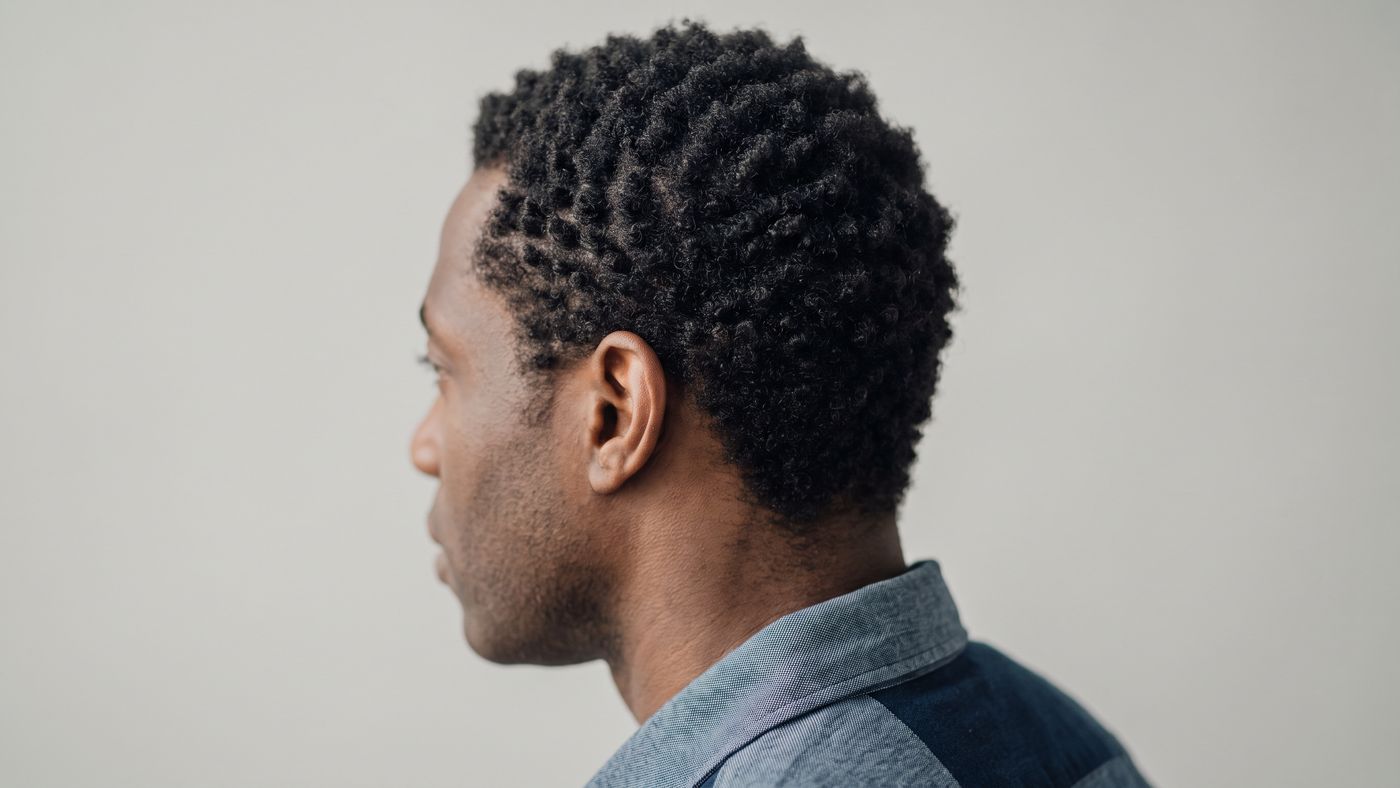
| Hair type | What changes | Practical note |
|---|---|---|
| Straight, coarse | Strong coverage per graft | Both methods work well; density goals are easier to reach |
| Fine or light-colored | Less coverage per graft | Higher planned density and good magnification matter |
| Wavy | Waves add visual fullness | Site direction should follow the natural wave pattern |
| Curly or afro-textured | Follicles curve beneath the skin | Curved grafts can be harder to load into implanter needles, so many surgeons prefer channel-based placement |
| Grey or white | Low contrast with the scalp | Can look full with fewer grafts, but hairs are harder to see during surgery |
Tightly curled hair also changes extraction, because the punch has to follow the curve of each follicle beneath the skin. Read more about our afro hair transplant approach.
Recovery compared
Recovery is similar: small crusts for about a week, redness fading over two to three weeks and a return to desk work in three to five days. Some patients notice slightly less redness in DHI areas because no channels are pre-opened, but differences are modest.
| Milestone | Sapphire FUE | DHI |
|---|---|---|
| Back to work | 3–5 days | 3–5 days |
| Crusts gone | ~10 days | ~7–10 days |
| Visible growth | Month 4–6 | Month 4–6 |
| Final result | Month 12 | Month 12 |
What the procedure day feels like
Both techniques are performed under local anesthesia while you are awake, usually lying face down for extraction and reclining for implantation. You can listen to music or watch something, and there are breaks for meals.
| Topic | Sapphire FUE | DHI |
|---|---|---|
| Typical length for about 2,500 grafts | About 6–8 hours | Often longer for the same count |
| Recipient-area numbing | Before channels are opened | Before implantation begins |
| Rhythm of the day | A focused channel-opening phase, then steady placement | A continuous cycle of loading and implanting |
| Leaving the clinic | Donor area often dressed; recipient area usually left uncovered | Same |
With either method, you go home the same day with written instructions and return the next day for your first wash and check. At HAIROCKET, that visit takes place at our clinic in Tamarac, followed by check-ins at months 3, 6, 9 and 12. The recovery timeline covers the weeks in between.
Cost compared
DHI takes more surgical time per graft, so clinics often price it slightly higher. At HAIROCKET, Sapphire FUE is part of fixed-price packages — see pricing.
Common myths
- "DHI doesn't require shaving." Partial shaving is still common for the donor area.
- "Sapphire FUE leaves scars." Like all FUE, donor points heal into tiny dots, not a linear scar.
- "One technique grows better." Growth depends on the surgeon and team more than the technique name.
Beyond the label: what actually decides your result
Technique names are also marketing terms. "Sapphire" describes only the blade material used to open channels, and "DHI" is sometimes used loosely for any procedure that uses an implanter pen. Two clinics offering the same named technique can deliver very different results, so a Sapphire FUE vs DHI comparison only goes so far.
Ask about the variables that matter instead:
- Who designs the hairline and who creates the recipient sites: the surgeon or technicians
- How long grafts are typically kept outside the body, and how they are stored
- The planned density per square centimeter in each zone
- The planned graft count, split by one-, two- and three-hair grafts
- How many patients the team treats on the same day
- What follow-up looks like over the next 12 months
A clinic that answers these clearly is telling you more than a technique name ever could. For a broader look at extraction methods, see FUE vs FUT.
How your surgeon decides
Your surgeon considers the size of the area, your donor supply, your hair type and your lifestyle. In many cases the best answer is a combination. At your free analysis, you'll get a written recommendation and the reasons behind it.
Frequently asked questions
Is DHI better than Sapphire FUE?
Neither is universally better; DHI suits hairlines, Sapphire FUE suits density over larger areas.
Which heals faster?
Both heal quickly; differences are small and depend on the individual.
Can I combine them?
Yes — combining DHI at the hairline with Sapphire FUE behind it is common.
Which is more expensive?
DHI is often slightly more expensive because it takes more surgical time.
Does DHI leave scars?
Like all FUE methods, donor points heal as tiny dots; there's no linear scar.
Is DHI more painful than Sapphire FUE?
Both are done under local anesthesia and feel similar for most patients. DHI sessions can take longer because each graft is placed with the implanter.
Which technique is best for the crown?
Sapphire FUE is usually preferred for the crown because it's efficient for larger areas.

HAIROCKET editorial team
Written in South Florida from the questions patients ask most in consultations, and updated when techniques, prices or guidelines change. Read our editorial policy.