

Short on time? Summarize with AI
Open this article in your favorite AI assistant for an instant summary.
In this article
- Why "best hair transplant clinic" lists disagree
- What makes a hair transplant clinic one of the best: 8 criteria
- How to check a hair transplant surgeon in 15 minutes
- Techniques and devices: what the labels mean
- How U.S. clinics price a hair transplant
- Well-known hair transplant clinics in the USA (unranked)
- Is the best clinic worth a flight?
- Red flags when choosing a hair transplant clinic
- Questions to ask at every consultation
- Is the best hair transplant in the USA or in Turkey?
- Where HAIROCKET fits, and how to check us
Why "best hair transplant clinic" lists disagree
Search for the best hair transplant in the USA and you'll find lists that barely overlap. That isn't surprising. There is no public registry of hair transplant outcomes in the U.S., graft survival isn't reported in a standard way, and before-and-after photos are chosen by the clinic that took them. Every ranking is therefore someone's judgment, and the useful question is whose judgment it is and what it is based on.
- Who publishes it? A clinic, a directory that sells listings, an affiliate site paid per referral, a professional association or a patient forum. Each has different incentives.
- Are the criteria stated? A list that doesn't explain how clinics were chosen is closer to advertising than to a guide.
- Can you check the facts? Names, licenses, techniques and prices should be traceable to a source you can open yourself.
Since October 2024, the Federal Trade Commission's rule on consumer reviews and testimonials bars businesses from running a company-controlled review website that claims to be independent. HAIROCKET is a clinic, so this page makes no independent-review claim and ranks no one.
What makes a hair transplant clinic one of the best: 8 criteria
Fame, price and technology labels tell you little on their own. These are the points that surgeons' own professional bodies and dermatologists point to, and each of them can be checked before you pay a deposit.
| Criterion | What good looks like | How to check it |
|---|---|---|
| Licensed physician | An active medical license in the state where the surgery takes place, with no unexplained public actions | DocInfo.org (Federation of State Medical Boards) or the state medical board; in Florida, the MQA Search Portal |
| Who does what | A licensed physician handles the evaluation, planning, hairline design, donor harvesting and recipient-site creation, as the ISHRS recommends | Ask who performs each step on your day, and get the answer in writing |
| Focus | Hair restoration is the main part of the surgeon's practice, not an occasional add-on | Ask how many hair transplants the surgeon performs and for how many years |
| Credentials | Hair-restoration credentials that can be verified, such as ABHRS certification or ISHRS membership | The ABHRS diplomate list and the ISHRS find-a-doctor directory |
| Results | Many cases at 12 months, with hair type and loss patterns similar to yours, photographed in the same light and angle | Ask for cases operated on by your surgeon, not the clinic's best-ever set |
| Long-term plan | A design that fits your age and protects donor hair if hair loss continues | Ask how the plan would change if you lose more hair over the next ten years |
| Written price | A total that states the graft count or limit, medications, follow-up and anything that costs extra | Compare full written quotes side by side |
| Follow-up | Scheduled reviews through month 12 and a named contact for problems | Ask who answers a question on a weekend in the first week |
No single criterion decides it. A famous surgeon who delegates most of the procedure, a low price with an unclear graft count, or beautiful photos that aren't from your surgeon each tell you something important that a ranking would hide.
How to check a hair transplant surgeon in 15 minutes
You don't need insider knowledge to check a surgeon. You need the right name and a few public databases, and most patients can do it in a quarter of an hour.
- 1. Get the operating physician's full name. Not the clinic's brand or founder: the doctor who will be in the room on your day.
- 2. Look up the license. DocInfo.org, run by the Federation of State Medical Boards, searches license and public disciplinary information across states. For Florida, the Department of Health's MQA Search Portal shows license status and any public discipline.
- 3. Check optional credentials. The American Board of Hair Restoration Surgery (ABHRS) lists its certified diplomates, and the International Society of Hair Restoration Surgery (ISHRS) has a find-a-doctor directory. Membership and certification aren't the same thing, and neither is legally required.
- 4. Ask who performs each step. The ISHRS position is that hairline design, donor harvesting and recipient-site creation belong to a licensed physician. Assistants commonly help with graft preparation and placement under supervision.
- 5. Ask for relevant results. Twelve-month photos of patients with your hair type and pattern, operated on by the same surgeon.
- 6. Get the plan in writing. Graft estimate, technique, total price, what is included and the follow-up schedule.
If a clinic can't or won't give you the operating physician's name before you pay, stop there. Every other step depends on it.
Techniques and devices: what the labels mean
Clinic websites often lead with a technique or a device name. These labels describe how grafts are harvested or placed; they don't tell you who is doing the work or how well. Here is what the common terms mean and what to ask about each.
| Term | What it is | What to ask |
|---|---|---|
| FUE | Follicular units are removed one at a time with a small punch, leaving small dot scars | Manual, motorized or robotic punch? Who makes the extractions? |
| FUT (strip) | A thin strip of scalp is removed and divided into grafts; leaves a linear scar | How is the scar closed, and how does it affect short haircuts? |
| DHI / implanter pens | Grafts are loaded into pens and placed directly, without separately made channels | Who designs the sites and who loads and places the grafts? |
| Sapphire FUE | FUE in which the recipient channels are made with sapphire blades | Who opens the channels, and at what density? |
| Robotic or motorized systems | Devices that assist FUE harvesting; brand names describe the tool, not the result | How much of the harvest does the physician control, and what is the transection rate? |
For more detail, see our complete FUE guide, FUE vs FUT and Sapphire FUE vs DHI.
How U.S. clinics price a hair transplant
Two quotes for the same head can look very different depending on the pricing model. Most U.S. clinics charge per graft, commonly $4–$8 per graft; others quote by session or use fixed packages. None is automatically cheaper, so compare the written total and what it includes.
| Pricing model | How it works | Watch for |
|---|---|---|
| Per graft | The total is the number of grafts times the rate; 2,500 grafts at $4–$8 is about $10,000–$20,000 | Graft counts that grow on the day; extras such as PRP or medication billed separately |
| Per session | A price for a day's work, often with a graft range | What happens if you need more or fewer grafts than the range |
| Fixed package | One price for a defined procedure and aftercare | Whether the package limits grafts, and what follow-up it covers |
Our hair transplant cost guide breaks costs down by graft count, and the pricing page shows how our packages are structured.
Well-known hair transplant clinics in the USA (unranked)
The clinics below are well known and appear often when Americans search for the best hair transplant in the USA. They are grouped by region, not ranked. Every fact comes from the clinic's own website as checked on September 30, 2026, and inclusion is not an endorsement. HAIROCKET has no affiliation with any of them. Details change, so confirm everything with the clinic before you decide.
blog-best-hair-transplant-clinics-usa-regions.jpg · 16:9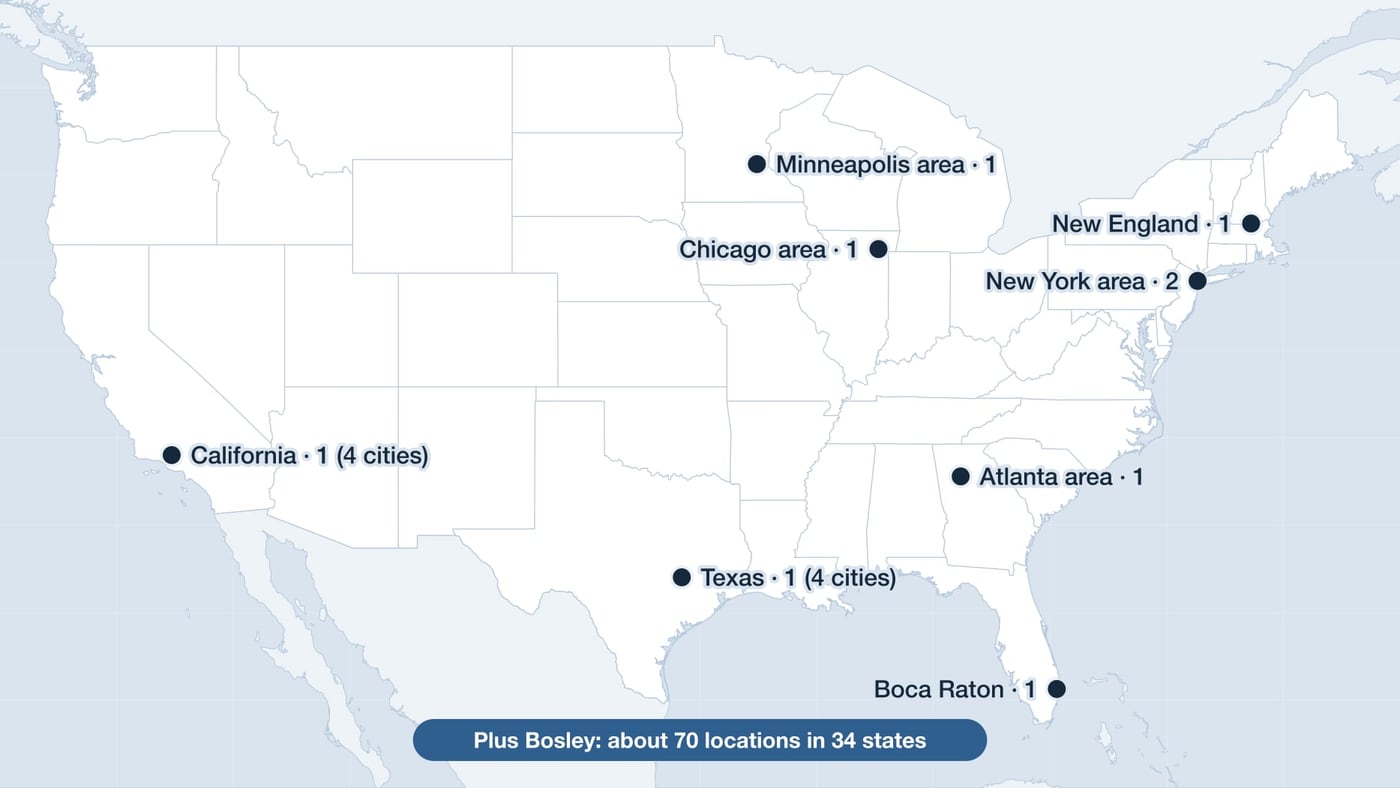
| Clinic | Where | Techniques listed on its site | Published pricing |
|---|---|---|---|
| Bernstein Medical | New York, NY | FUT, FUE, robotic FUE (ARTAS), repair, PRP, SMP | $250 physician evaluation; surgery priced by graft count, no rate published |
| The Hair Loss Doctors by Robert J. Dorin | Garden City and New York, NY; Short Hills, NJ | FUT, FUE, PRP, laser therapy, eyebrow and beard | $225 consultation; priced per graft, no rate published |
| DiStefano Hair Restoration Center | Five New England offices (MA, RI, NH, CT) | FUE, FUT, no-shave FUE, SMP, laser and topical therapy | Not published; free consultations |
| Shapiro Medical Group | Bloomington, MN | FUE, FUT, SMP, PRP, laser therapy, repair | By procedure and graft count; no figures published |
| Chicago Hair Institute | Oakbrook Terrace, IL | FUE, strip harvesting, body-to-scalp, eyebrow and beard | Not published |
| Anderson Center for Hair | Atlanta and Alpharetta, GA | FUT, FUE, robotic FUE (ARTAS), PRP, SMP | Quoted after consultation; states it does not charge per graft |
| Bauman Medical | Boca Raton, FL (also New York, NY) | FUE, NeoGraft FUE, repair, PRP, SMP, laser therapy | Not published |
| Arocha Hair Restoration | Houston, Dallas, Austin and San Antonio, TX | FUE, FUT, robotic FUE (ARTAS), repair, SMP | From $4,000; FUE $4,000–$15,000; FUT $4,000–$10,000 |
| Parsa Mohebi Hair Restoration | Beverly Hills, Woodland Hills, San Francisco and San Diego, CA | FUE, FUT, female hairline lowering, repair, SMP | $2 to more than $10 per graft, depending on the procedure |
| Bosley | About 70 locations in 34 states (per its site) | FUE, FUT, hybrid FUE/FUT, PRP, SMP, laser therapy | Typically $4,400–$12,000 |
Bernstein Medical
The practice is led by Robert M. Bernstein, MD, whom the site describes as board-certified in dermatology and certified by the ABHRS, with Christine M. Shaver, MD, as medical director. It offers a free photo assessment, which the site notes is not a virtual consultation.
The Hair Loss Doctors by Robert J. Dorin
Formerly True & Dorin Medical Group, the practice is led by Robert J. Dorin, DO, listed on its site as an ABHRS diplomate and ISHRS member. Virtual appointments are offered.
DiStefano Hair Restoration Center
Chris Heinis, MD, whom the site describes as a board-certified emergency physician focused on hair restoration, leads the practice. Consultations can be in person or by video, and the site mentions interest-free financing for up to 12 months.
Shapiro Medical Group
The site names Ron Shapiro, MD, Paul Shapiro, MD, and David Josephitis, DO, and states that all three are ABHRS diplomates and ISHRS members. Phone or video consultations require specific photos in advance.
Chicago Hair Institute
Raymond J. Konior, MD, FACS, is described on the site as a founding member of the ABHRS; Qutaibah Khatib, MD, and Sahar Nadimi, MD, are also listed. The site offers virtual consultations based on photos and a form.
Anderson Center for Hair
Ken Anderson, MD, is described on the site as certified by the ABHRS and by facial plastic and otolaryngology boards, and as an ISHRS Fellow; Jeremy Wetzel, MD, is also listed. Consultations are in person or virtual.
Bauman Medical
Founded in Boca Raton in 1997, according to its site, and led by Alan J. Bauman, MD, whom the site lists as ABHRS-certified and an ISHRS Fellow. Video consultations are offered.
Arocha Hair Restoration
Bernardino A. Arocha, MD, is listed on the site as an ABHRS diplomate and ISHRS Fellow, and the practice states that it focuses solely on hair restoration. Free virtual consultations are offered.
Parsa Mohebi Hair Restoration
Parsa Mohebi, MD, is listed on the site as an ABHRS diplomate and ISHRS Fellow. Phone and video consultations require a form and photos; the site lists a consultation fee credited toward the procedure.
Bosley
A national multi-location company. Its site lists Ken Washenik, MD, PhD, as chief medical officer and names physicians by office, so ask which physician would operate on you and check that person directly.
Spotted an outdated detail? Tell us through our editorial policy page and we will correct it.
Is the best clinic worth a flight?
For many patients the best surgeon for them isn't the closest one. A domestic flight is a small part of a decision that lasts decades, and many clinics start with a photo review or video consultation so you only travel once, for the procedure.
- Plan the stay around the first wash. Many clinics want to see you the morning after surgery; most out-of-town patients plan one to three nights.
- Ask how follow-up works from home. Video reviews at months 3, 6 and 9 are common; find out which visits must be in person.
- Know who you'd call locally. Tell your own doctor about the procedure, and agree in advance on what the clinic does if you need to be seen near home.
- Keep the flight home simple. A loose button-up shirt, a clean loose cap and a neck pillow so the grafts don't touch the seat.
Our travel guide covers timing, packing and flying home with fresh grafts.
Red flags when choosing a hair transplant clinic
Most problems are visible before you pay. These signs don't prove a clinic is unsafe, but each one deserves a clear answer.
| Red flag | Why it matters |
|---|---|
| A firm price before anyone has seen your scalp | Graft needs depend on your pattern, donor density and goals; a price without an assessment is a sales figure |
| "Unlimited grafts" or very large promised counts | Your donor area is finite; over-harvesting can leave visible thinning at the back |
| The surgeon's name isn't given, or changes | You can't verify a license, training or results without it |
| Technicians described as doing "the whole procedure" | The ISHRS considers hairline design, harvesting and site creation to be physician tasks |
| Discounts that expire today | Pressure to decide quickly is a sales tactic, not a medical one |
| Only best-case photos, none at 12 months | Final results take about a year; early photos can flatter |
| No written plan or follow-up schedule | Without them, there is nothing to hold the clinic to |
Questions to ask at every consultation
Ask every clinic the same questions and write the answers down. Differences are much easier to see on paper than in a friendly sales call.
- Who is the operating physician, and what is their license number?
- Which steps will the physician perform personally, and which will assistants perform?
- How many grafts do you estimate for me, and why that number?
- How does this plan protect my donor area if my hair loss continues?
- Can I see 12-month results from this surgeon for patients like me?
- What exactly does the price include, and what could cost extra on the day?
- What is the follow-up schedule, and who do I contact if something worries me in the first week?
- Should I start or continue medical treatment alongside the surgery?
Is the best hair transplant in the USA or in Turkey?
Many Americans compare U.S. clinics with packages in Istanbul. The same rules apply abroad: the surgeon's name, license, role on the day and follow-up matter more than the country. The difference is how hard those points are to check from a distance and what happens if you need to be seen after you fly home. Read is a hair transplant in Turkey safe?, our line-item Turkey cost guide and the Turkey vs USA comparison.
Where HAIROCKET fits, and how to check us
HAIROCKET is a hair transplant clinic in Tamarac, Florida, in central Broward County near Fort Lauderdale. Our surgeons trained in Turkey's high-volume FUE clinics and hold Florida medical licenses. We perform Sapphire FUE, with unshaven FUE, crown restoration and female hair transplant among our treatments, and we use fixed-price packages of $5,500, $5,750 and $8,000 instead of per-graft pricing.
We left ourselves out of the table above, because a clinic can't be a neutral judge of itself. Hold us to the same standard: before you book, ask for the name and Florida license number of the surgeon who will operate on you and check it on the MQA Search Portal; ask who performs each step; and ask for your plan and total price in writing. You can start with a free photo analysis.
Frequently asked questions
What is the best hair transplant clinic in the USA?
There is no objective answer, because U.S. clinics don't publish outcomes in a common format. The best clinic for you is one where a licensed physician who focuses on hair restoration plans and performs the critical steps, shows you 12-month results for patients like you, and gives you a written plan and total price. Use the 8 criteria and the 15-minute check in this guide to compare clinics yourself.
Who is the best hair transplant surgeon in the US?
Rankings of individual surgeons are opinions, and many are published by clinics or directories with a commercial interest. Instead of looking for a single name, check the surgeon's license on DocInfo.org or the state board, confirm which steps they perform personally, and review their own 12-month results.
How much does a hair transplant cost at a top U.S. clinic?
Most U.S. clinics price per graft, commonly $4–$8, so 2,500 grafts is roughly $10,000–$20,000. Some clinics quote per session or use fixed packages. Compare the written total, including medications, follow-up and anything billed on the day.
Is board certification required for hair transplant surgeons?
A medical license is required; hair-restoration certification is not. The American Board of Hair Restoration Surgery (ABHRS) certifies physicians who apply and meet its requirements, and the ISHRS is a professional society. Both can be checked, but a surgeon without them isn't automatically unqualified, and one with them still needs to show you relevant results.
Is a robotic hair transplant better?
Not automatically. Robotic and motorized systems assist the harvesting step of FUE. Results depend much more on planning, the operator's experience, graft handling and placement. Ask how much of the harvest the physician controls and to see results from that clinic's own patients.
Are online rankings of hair transplant clinics reliable?
Treat them as a starting point. Check who publishes the list and whether the criteria are stated. Since October 2024, an FTC rule bars businesses from running a company-controlled review website that claims to be independent, so a clinic-published list should say so clearly.
Is it worth traveling to another state for a hair transplant?
It can be. Many clinics review photos and hold consultations by video, so you travel once for the procedure and usually stay one to three nights. Before you book, ask how follow-up works from home and what happens if you need to be seen locally.
Sources and further reading
- International Society of Hair Restoration Surgery (ISHRS) — Beware of Unlicensed Technicians Performing Hair Restoration Surgery
- International Society of Hair Restoration Surgery (ISHRS) — FUE Hair Transplant: Benefits, Process & Recovery
- American Academy of Dermatology — A hair transplant can give you permanent, natural-looking results
- Cleveland Clinic — Hair Transplant: How Does It Work, Success Rates
- Federal Trade Commission — Federal Trade Commission Announces Final Rule Banning Fake Reviews and Testimonials (Aug 2024)
- Federation of State Medical Boards — DocInfo.org — physician license and disciplinary search
- Florida Department of Health — FL DOH MQA Search Portal — License Verification

HAIROCKET editorial team
Written in South Florida from the questions patients ask most in consultations, and updated when techniques, prices or guidelines change. Read our editorial policy.