
Short on time? Summarize with AI
Open this article in your favorite AI assistant for an instant summary.
In this article
- What is an FUE hair transplant?
- FUE vs strip surgery at a glance
- The FUE procedure day, step by step
- Manual, motorized and robotic extraction
- Who is a good candidate for FUE?
- FUE recovery and results timeline
- Risks of FUE and how they are kept low
- FUE hair transplant cost in Florida and the U.S.
- How to choose an FUE surgeon
- FUE recovery in Florida: sun, humidity and water
- How FUE works at HAIROCKET
What is an FUE hair transplant?
FUE stands for follicular unit excision, a method of moving hair that is still commonly called follicular unit extraction. The surgeon removes individual follicular units, the natural groups of one to four hairs, from the back and sides of the scalp. Those grafts are then implanted where hair has thinned or receded.
The professional society for hair restoration surgeons now prefers the word excision. The change was made to stress that harvesting grafts is real surgery that needs a physician's judgment, not a cosmetic add-on. Thousands of tiny round incisions are still surgery, even without stitches.
Grafts are removed with a hollow micro-punch, usually between 0.7 and 1.2 mm wide. Each opening heals on its own into a small dot. The donor hair used comes from a zone that is generally resistant to pattern hair loss, which is why transplanted hair tends to keep growing for the long term.
FUE is a family, not a single technique
Names you see in clinic ads usually describe one step of FUE, not a different operation. Sapphire FUE refers to the blade used to open recipient channels. Unshaven FUE refers to how much hair is trimmed. Implanter-pen methods change how grafts are placed. The extraction step is the same idea in all of them.
FUE vs strip surgery at a glance
There are two ways to harvest donor hair. FUE takes follicles one at a time. Strip surgery (FUT) removes a thin band of scalp that is then cut into grafts under microscopes. Once implanted, a follicle does not know how it was harvested. The differences show up in the donor area.
| Topic | FUE | Strip (FUT) |
|---|---|---|
| How grafts are harvested | One follicular unit at a time with a micro-punch | A strip of scalp is removed and dissected |
| Donor marks | Many small dot scars, spread out | One fine linear scar |
| Stitches | None | Stitches or staples, removed later |
| Short haircuts at the back | Usually fine | The line may show with very short hair |
| Donor discomfort | Usually mild | Tightness is common for a few weeks |
| Donor area shaving | Usually trimmed; unshaven options exist for smaller sessions | Not needed |
Most people who keep their hair short at the back choose FUE. Strip surgery can still make sense for some very large sessions or repair cases. For scars, graft yield and who suits each method, read FUE vs FUT.
The FUE procedure day, step by step
An FUE hair transplant is an outpatient procedure done under local anesthesia while you are awake. Dermatologists describe a typical session as lasting four to eight hours. Larger sessions sit at the long end of that range. Here is what happens, in order.
1. Consultation review and hairline design
The surgeon confirms your medical history, medications and the plan agreed at consultation. The hairline and recipient zones are drawn on your scalp, usually while you look in a mirror. The safe donor zone is marked, and the donor area is trimmed short unless you are having an unshaven method.
2. Local anesthesia
The donor area is numbed first. You feel the first injections, then pressure without sharp pain. The recipient area is numbed later, before channels are opened. Top-ups are given through the day so you stay comfortable.
3. Extraction with a micro-punch
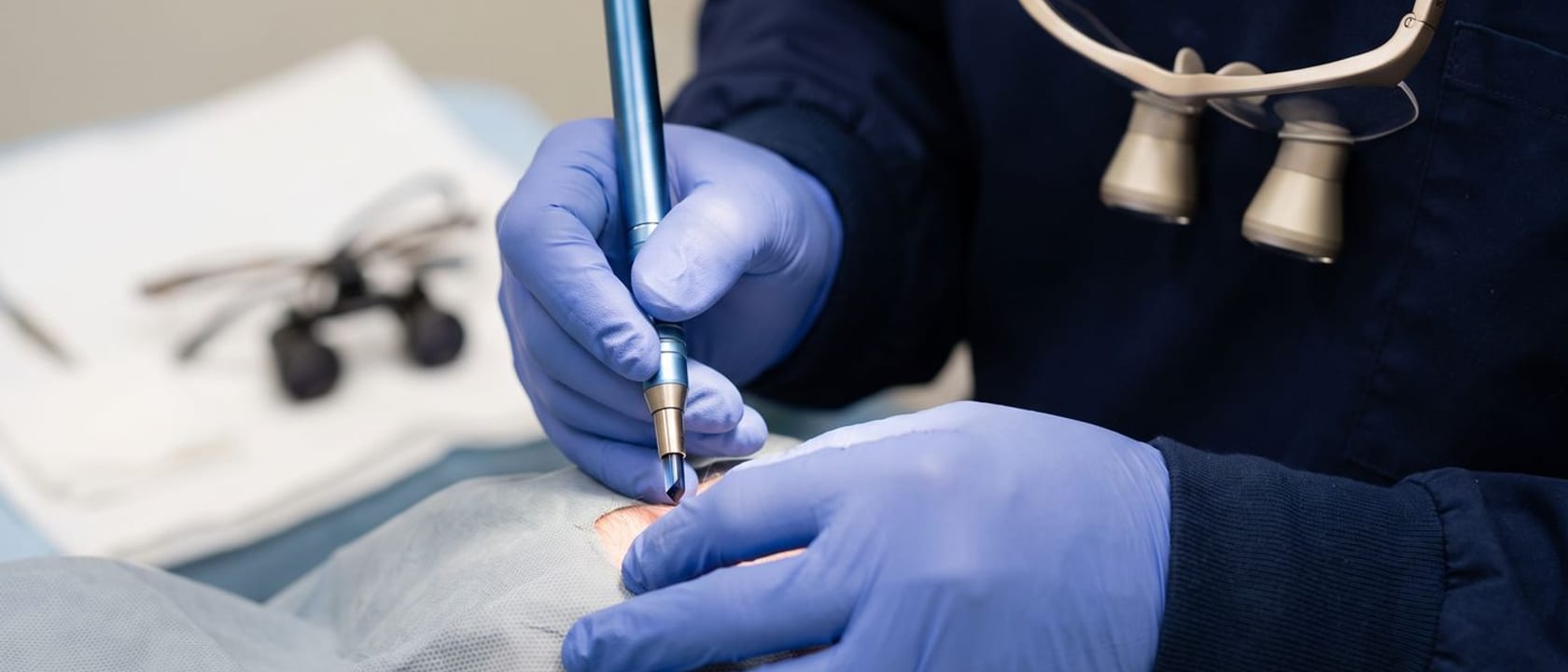
You usually lie face down while grafts are removed. The punch scores the skin around each follicular unit, and the graft is lifted out with fine forceps. Extractions are spread evenly across the donor zone so no single patch looks thin. This is the longest phase of the day.
4. Graft handling
Grafts are counted, checked under magnification and sorted by the number of hairs they contain. Single-hair grafts are usually saved for the front edge of the hairline. Grafts are kept moist and chilled in a holding solution, because follicles that dry out or sit too long are less likely to grow.
5. Recipient channels: steel vs sapphire
The surgeon opens a tiny channel for every graft. This is where the angle, direction and density of your future hair are set. Channels are usually made with fine steel blades or needles, or with sapphire blades.
| Topic | Steel blades or needles | Sapphire blades |
|---|---|---|
| Material | Surgical steel | Synthetic sapphire crystal |
| Incision shape | Slit or small round opening, depending on the tool | Fine V-shaped slit |
| Edge | Sharp; may dull over many incisions | Very fine edge that stays sharp |
| Where used | Widely used worldwide | Popular in high-volume Turkish clinics |
| What matters most | Channel size, depth and angle set by the surgeon | Channel size, depth and angle set by the surgeon |
Surgeons who use sapphire blades value the fine, consistent slits for dense, even placement. Direct comparisons between the two materials are limited, and a well-made steel channel can also give an excellent result. The skill of the person making the channels matters more than the material.
6. Placement
Grafts are placed one by one into the channels, following the direction and density map. Placement in pre-made channels is usually done with fine forceps. Implanter-pen methods create the opening and place the graft in one motion; Sapphire FUE vs DHI covers that difference in detail.
How long each step takes
| Step | Typical time for a mid-size session (about 2,500 grafts) | Your position |
|---|---|---|
| Design, photos, marking | 30–60 minutes | Seated |
| Local anesthesia | 20–40 minutes | Face down, then reclined later |
| Extraction | 2–4 hours | Face down |
| Graft sorting | Runs alongside extraction | — |
| Recipient channels | 45–90 minutes | Reclined |
| Placement | 2–3 hours | Reclined |
| Aftercare briefing and discharge | 20–30 minutes | Seated |
Times vary with graft count, hair type and the team. Most clinics build in a meal break. You go home the same day with written instructions and a driver or companion.
Manual, motorized and robotic extraction
FUE punches come in three broad forms. All of them do the same job: free one follicular unit at a time. None is automatically better; each has trade-offs, and results depend far more on the operator and the plan.
| Topic | Manual punch | Motorized punch | Robotic system |
|---|---|---|---|
| How it works | Surgeon rotates the punch by hand | A handpiece spins or oscillates the punch | An image-guided arm selects and scores follicular units |
| Strengths | High tactile feedback; suits delicate or curly hair | Faster; less hand fatigue in long sessions | Consistent spacing and depth on suitable hair |
| Limitations | Slower; tiring for very large sessions | Speed can raise damage if poorly controlled | Less suited to some hair colors and textures; still needs a surgeon to plan and to create sites |
| Who controls quality | The surgeon | The surgeon | The surgeon who sets parameters and supervises |
The number to ask about is transection: follicles cut or damaged during extraction. The hair restoration society describes a transection rate of 3% or lower as good to excellent, and above 5% as poor. A surgeon who tracks this can tell you roughly where they stand, whichever device they use.
Who is a good candidate for FUE?
Dermatologists list two basic requirements. You need enough healthy donor hair to move, and the thinning area must still be able to grow hair. Everything else is detail within those two points.
- Stable, diagnosed pattern hair loss. Receding temples, a thinning crown or a mid-scalp that has thinned gradually.
- Good donor density at the back and sides, without thinning in that zone.
- Realistic goals. A fuller head of hair, not the density you had at 18.
- A long-term plan that allows for further loss of the native hair around the grafts.
- Good general health and no active scalp infection or inflammation.
FUE is often not the right first step if shedding is sudden, patchy or undiagnosed, if hair is sparse all over including the donor area, or if loss is very advanced and donor supply is limited. Younger patients whose pattern is still developing may be advised to wait and start medical treatment first.
See am I a good candidate for a hair transplant for the full checklist, and how many grafts do I need for typical ranges by pattern.
FUE recovery and results timeline
Visible healing is quick. Growth is slow. Knowing the order helps you avoid worrying at the wrong moments.
| When | What usually happens | What you do |
|---|---|---|
| Day 1 | Tenderness, tight feeling, small crusts forming | First wash and check as instructed; sleep with head raised |
| Days 2–7 | Swelling may move to the forehead; crusts around grafts | Gentle washing; no rubbing, scratching or tight hats |
| Days 7–14 | Crusts clear; donor dots fade; redness settles | Most desk work resumes within days; follow activity limits |
| Weeks 2–8 | Transplanted hairs shed; this is expected | Keep to your routine; shedding does not mean failure |
| Months 3–4 | New hairs start to appear, often fine at first | First progress photos |
| Months 6–9 | Clear visible change for most people | Mid-point review with your surgeon |
| Month 12 and beyond | Final density and texture; the crown can take longer | Final review and long-term plan |
Dermatologists note that most people see results between six and nine months, and some need 12 months. The day-by-day version is in the hair transplant recovery timeline.
Risks of FUE and how they are kept low
FUE is generally safe when a trained surgeon plans it well. Complications do happen. Most are minor and temporary, and most are made less likely by decisions made before the first graft is taken.
| Risk | What it is | How it is minimized |
|---|---|---|
| Overharvesting | Too many grafts taken from one area, leaving the donor zone visibly thin or patchy. Donor hair does not grow back once removed. | Spreading extractions evenly and taking only a limited share of the follicular units in each area per session. A 2026 review cites 10–20% of baseline density per session as a common limit. |
| Infection | Redness, pain, warmth or discharge that worsens after the first days | Sterile technique, clean washing routine and avoiding thick crusts. The same review reports infection in under 1% of cases. |
| Folliculitis | Small, pimple-like bumps as new hairs push through, often weeks 1–4 or later during regrowth | Gentle cleansing and warm compresses; antibiotics if the surgeon decides they are needed. High-density megasessions, delayed washing and hot weather are reported risk factors. |
| Shock loss | Temporary shedding of existing native hair near the grafts, usually 2–8 weeks after surgery | Careful site density and planning; most shed hair regrows within months. See shock loss after a hair transplant. |
| Transection | Follicles cut during extraction and less likely to grow | Correct punch size and angle; a surgeon who tracks their rate |
| Donor white dots | Small pale marks that can show with a very close shave | Small punches and good spacing |
Call your surgeon promptly for spreading redness, increasing pain, pus or fever. Do not wait for a scheduled follow-up.
Two quieter risks deserve a mention. One is an unnatural hairline, usually from placing it too low or too straight for your age. The other is a graft count that does not match what you paid for. The professional society has warned about clinics where unlicensed staff perform surgery and graft numbers are overstated. Asking who does each step, below, protects you from both.
FUE hair transplant cost in Florida and the U.S.
Most U.S. clinics price FUE per graft, commonly between $4 and $8 per graft. That makes the total depend heavily on the graft count. It is also why two quotes that look similar can end up thousands of dollars apart.
| Grafts planned | At $4 per graft | At $6 per graft | At $8 per graft | HAIROCKET fixed package |
|---|---|---|---|---|
| 1,500 | $6,000 | $9,000 | $12,000 | From $5,500 |
| 2,500 | $10,000 | $15,000 | $20,000 | From $5,500 |
| 3,500 | $14,000 | $21,000 | $28,000 | From $5,500 |
HAIROCKET uses fixed packages instead of per-graft pricing. The price covers all the grafts your surgeon plans for the session: Essential $5,500, Signature $5,750 and Elite $8,000. The packages differ in what is included, such as PRP sessions, aftercare products and stem cell therapy in Elite, not in graft count. Details are on the pricing page.
What else to budget for
- Time off. Most desk workers take a few days to a week; physical jobs usually need longer.
- Medication and aftercare products, if not included in the quote.
- Maintenance treatment for native hair, such as medication or PRP (a single PRP session at HAIROCKET is $750).
- Follow-up visits. Local follow-ups cost little in time; long-distance ones add travel.
Example: comparing two quotes
Example (illustrative, not a real patient): a 38-year-old with Norwood 3 recession is told he needs about 2,500 grafts. A per-graft quote at $6 comes to $15,000, and could rise if more grafts are added on the day. A fixed package for the same plan is one number agreed in writing beforehand. The fair comparison is the total, what is included, and who performs each step, not the price per graft.
For a full breakdown, see the hair transplant cost guide for Florida. Patients weighing a trip abroad can compare the full picture in hair transplant Turkey vs USA.
How to choose an FUE surgeon
Results depend largely on the surgeon and team. The hair restoration society's position is that a licensed physician should handle the consultation and diagnosis, surgical planning, hairline design, donor harvesting, recipient site creation and management of any medical issues. Trained assistants commonly help with graft sorting and placement under supervision.
| Step | Who should be responsible | What to ask |
|---|---|---|
| Diagnosis and plan | Licensed physician | Who examines my scalp and decides the graft count? |
| Hairline design | Licensed physician | Will the surgeon draw it with me on the day? |
| Donor harvesting | Licensed physician, or a licensed extender where the law allows | Will anyone unlicensed be making incisions or harvesting grafts? |
| Recipient channels | Licensed physician | Who opens the channels and sets angle and density? |
| Graft sorting and placement | Trained team under supervision | How are grafts stored, and how long are they out of the body? |
| Follow-up | Surgeon and care team | Who reviews my growth at months 3, 6, 9 and 12? |
Checks you can do yourself
- Verify the license. In Florida, search the surgeon's name on the Florida Department of Health license verification portal. It shows license status and whether any discipline is on file. It is free.
- Ask for the transection rate and how it is measured.
- Ask how many patients the team treats on the same day.
- Ask for the graft count in writing, split into one-, two- and three-hair grafts, and how it will be confirmed on the day.
- Ask what happens if you need a second session and how much donor hair would remain.
If a clinic cannot answer these clearly, that is useful information in itself. More questions on technique choice are in FUE vs FUT.
FUE recovery in Florida: sun, humidity and water
Florida weather does not rule out surgery at any time of year, but it changes the first weeks of aftercare. Your surgeon's written instructions come first; these are the points patients here most often ask about.
- Sun. Keep the scalp out of direct sun while it heals. Once your surgeon allows it, wear a loose, breathable hat that does not rub the grafts. Scalp sunburn during healing can worsen redness and marks.
- Heat and humidity. Sweat and heat can irritate healing skin and are reported risk factors for folliculitis. Plan errands for cooler hours, stay in air conditioning where you can, and keep to your washing routine.
- Pools, ocean, hot tubs. Most surgeons ask you to keep your head out of the water for about two weeks, and longer for the ocean or hot tubs. Chlorine and salt water can irritate a healing scalp. Follow your own surgeon's timing.
- Boating and fishing. Long hours in open sun and wind are best postponed until the scalp has healed and you have been cleared.
- Exercise. Light walking is usually fine early; heavy sweating and contact sports wait longer. See exercise after a hair transplant.
A local surgeon also makes follow-up simple. Check-ins at months 3, 6, 9 and 12 are a short drive rather than a flight.
How FUE works at HAIROCKET
HAIROCKET performs Sapphire FUE at its clinic in Tamarac, in central Broward County near Fort Lauderdale. Surgeons are Turkish-trained and Florida-licensed. Unshaven FUE is available as a separately priced add-on for patients who want to keep more of their hair length.
- Free photo analysis from four photos: front, top, crown and sides.
- A written plan and all-inclusive quote within 24 hours.
- A video or in-person consultation.
- Procedure day in Tamarac, then your first wash and check the next day.
- Follow-ups at months 3, 6, 9 and 12.
You can estimate your graft range first with the free graft calculator, or send your photos through the contact page.
Frequently asked questions
How much does an FUE hair transplant cost?
In the U.S., FUE is commonly priced at about $4 to $8 per graft, so 2,500 grafts can cost roughly $10,000 to $20,000. Some clinics use fixed packages instead. HAIROCKET's packages start at $5,500 and cover all the grafts the surgeon plans for the session. Always compare the total, what is included and who performs each step.
Is an FUE hair transplant permanent?
Transplanted follicles come from a donor zone that is generally resistant to pattern hair loss, so they usually keep growing long term. Your native hair around them can still thin with age. That is why good planning allows for future loss and why some people use medication or PRP to protect the hair they have.
How long is FUE recovery?
Crusts usually clear in 7 to 14 days, and most desk workers are back within days to a week. Transplanted hairs shed in weeks 2 to 8. New growth commonly starts around months 3 to 4, with clear change by months 6 to 9 and the final result at about 12 months.
Does FUE leave scars?
Yes, but they are small. Each extraction heals into a tiny dot scar, spread across the donor area. With normal short haircuts these are usually hard to see. With a very close shave, some pale dots may show. FUE does not leave the single linear scar of strip surgery.
Is FUE painful?
FUE is done under local anesthesia while you are awake. The numbing injections at the start are the most noticeable part; after that, most people feel pressure rather than pain. Soreness and tightness for a few days afterward are common and are usually managed with the medication your surgeon prescribes.
Is robotic FUE better than manual FUE?
Not automatically. Manual, motorized and robotic devices all extract follicular units one at a time. Each has strengths and limits depending on hair type and session size. Results depend mainly on the surgeon's planning, transection rate, graft handling and site creation, so ask about those rather than the device.
Sources and further reading
- International Society of Hair Restoration Surgery (ISHRS) — FUE Hair Transplant: Benefits, Process & Recovery
- International Society of Hair Restoration Surgery (ISHRS) — Follicular Unit Extraction: It Has Grown in Popularity, but Transection Remains a Concern
- International Society of Hair Restoration Surgery (ISHRS) — Beware of Unlicensed Technicians Performing Hair Restoration Surgery
- International Society of Hair Restoration Surgery (ISHRS) — Hair Graft Placement: The Final Step in Hair Transplantation
- American Academy of Dermatology — A hair transplant can give you permanent, natural-looking results
- Frontiers in Medicine (2026), via PubMed Central — Complications in follicular unit excision hair transplantation: current evidence and practical approaches
- Florida Department of Health — MQA Search Portal: License Verification

HAIROCKET editorial team
Written in South Florida from the questions patients ask most in consultations, and updated when techniques, prices or guidelines change. Read our editorial policy.