

Short on time? Summarize with AI
Open this article in your favorite AI assistant for an instant summary.
In this article
- Receding hairline or mature hairline? How to tell
- Norwood 2 and Norwood 3 in plain words
- Who a hair transplant for a receding hairline suits
- Age: why under-25s get a conservative plan
- Non-surgical options to try first
- How many grafts a receding hairline needs
- How the new hairline is designed
- Unshaven FUE for people who cannot take time off
- Cost: Tamarac packages vs. per-graft pricing in Florida
- Recovery when the work is on your hairline
- Checklist before you book
Receding hairline or mature hairline? How to tell
Almost every man's hairline moves back a little after his teens. That change on its own is not hair loss, and it is not a reason for surgery. The question is whether your hairline has matured and stopped, or whether it is receding and still moving.
On the Norwood scale that surgeons use, stage 1 means "minimal or no recession of the hairline" and stage 2 means small, usually symmetrical triangles of recession at the temples. A mature hairline normally sits somewhere in that range. Male pattern hair loss, by contrast, can start as early as the late teens or early twenties and usually keeps progressing, according to the American Academy of Dermatology.
| Sign | More like a mature hairline | More like a receding hairline |
|---|---|---|
| Movement over time | Moved back slightly, then stayed put for a year or more | Still moving when you compare photos 6–12 months apart |
| Shape | Even, mild rise across the front with softly rounded temples | Temples dig back into deeper triangles, often faster than the middle |
| Hair at the edge | Hairs along the front look as thick as the rest | Finer, shorter, lighter hairs along the front edge and temples |
| Density behind the line | Normal density just behind the hairline | Thinning or a see-through zone behind the front edge |
| Family history | No strong pattern of early balding | Father, brothers or grandfathers balded early |
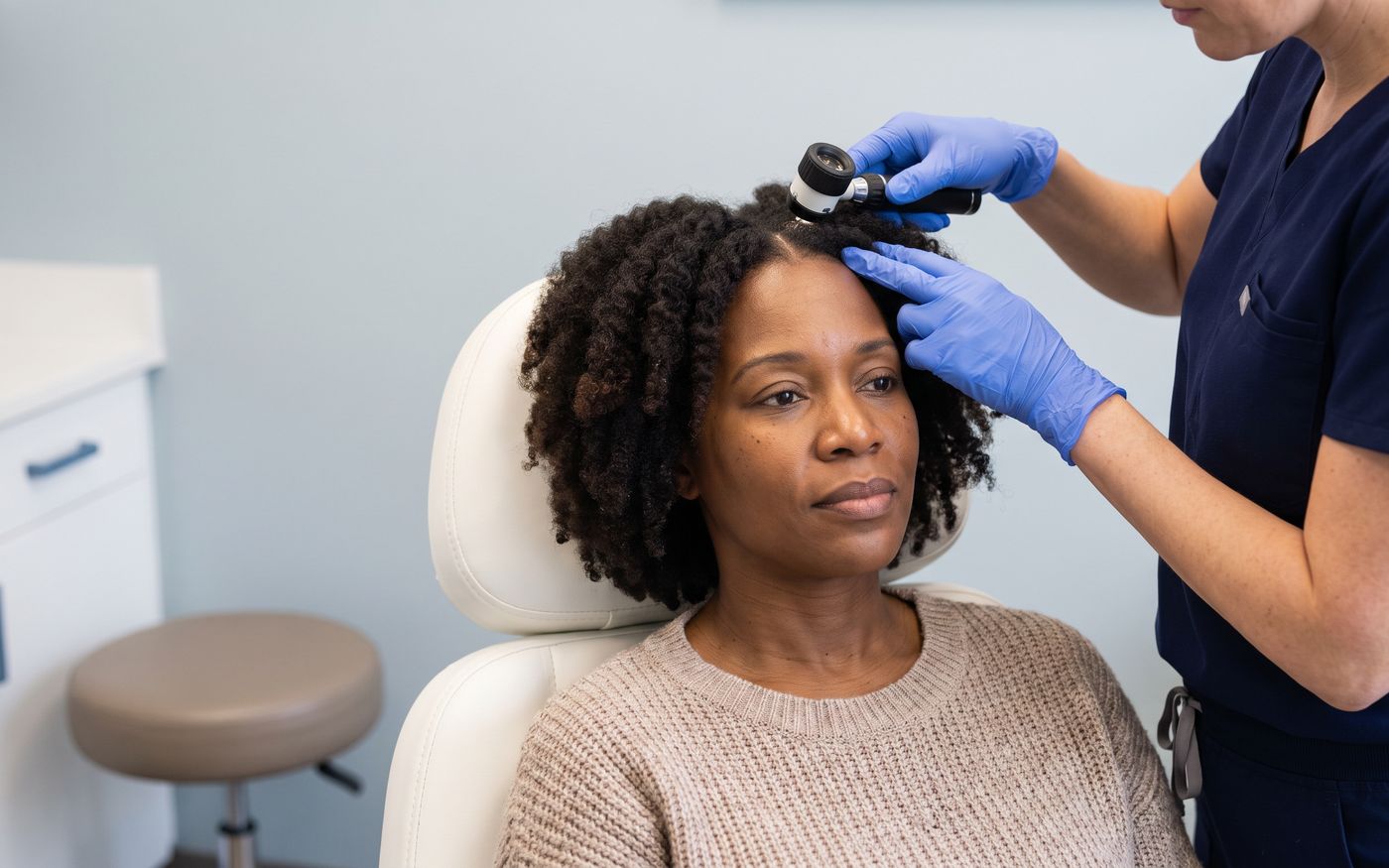
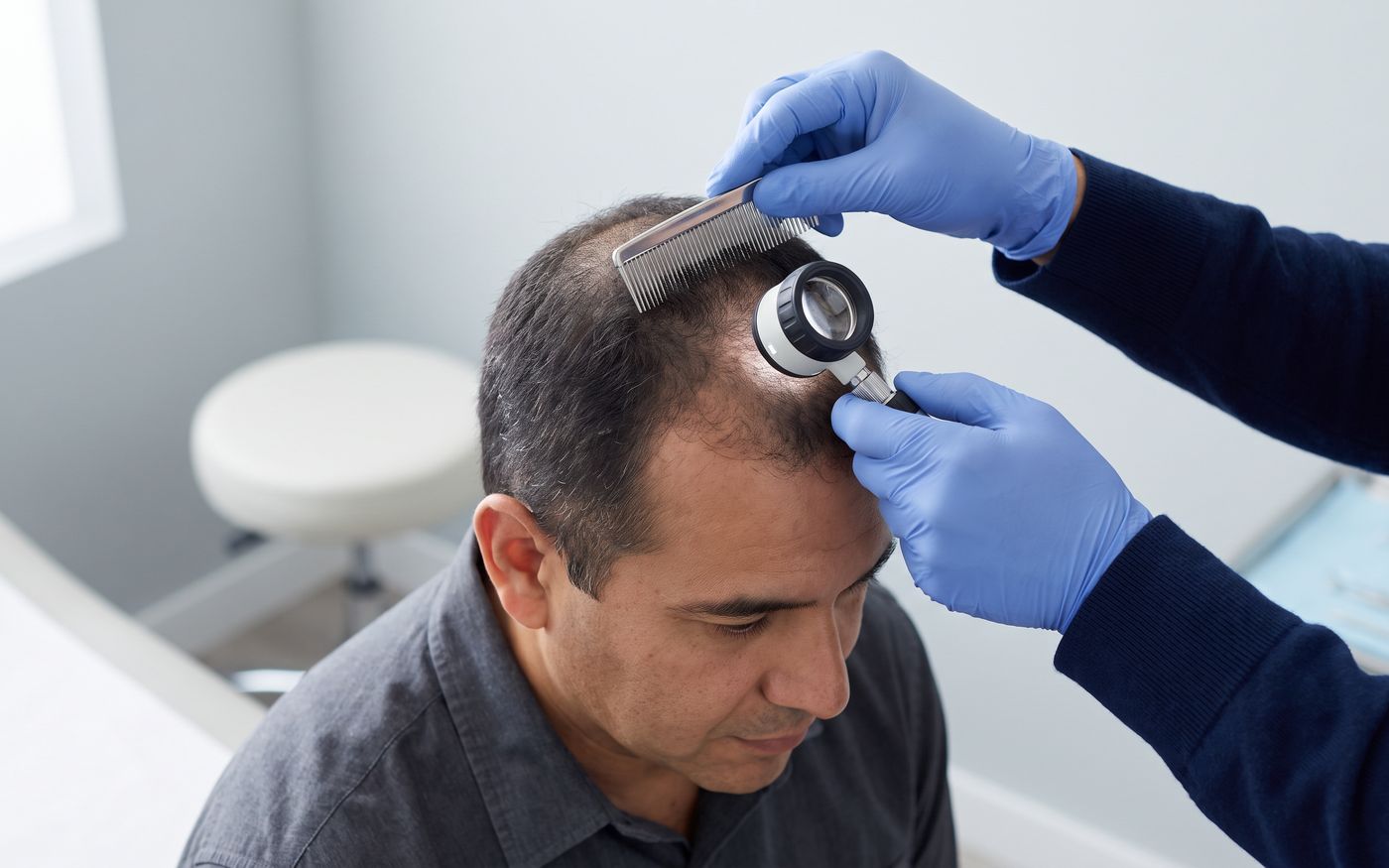
The most telling sign is miniaturization: hairs that grow back thinner with each cycle. A systematic review of trichoscopy (magnified scalp examination) found hair-diameter variability in about 94% of people with androgenetic alopecia, and it treats more than 20% variability in hair-shaft thickness in men as a diagnostic criterion. These changes are more prominent at the front than at the back of the scalp, which is why a surgeon compares the two.
A rough home check: take dated photos of your hairline with your hair pulled back, in the same light, every three months. Movement over a year matters more than where your hairline sits today. A dermatologist or hair surgeon can confirm miniaturization with magnification.
Norwood 2 and Norwood 3 in plain words
Most people searching for a hair transplant for a receding hairline are at Norwood 2 or 3. Here is what those stages mean without the jargon.
- Norwood 2: the corners at your temples have pulled back into small triangles. From the front, your hairline looks slightly M-shaped, but the middle is still close to where it was. Many men stay here for years, and for some it is simply their mature hairline.
- Norwood 3: the temple triangles are deep and bare or only sparsely covered. The classification describes stage 3 as the minimal amount of loss that counts as balding. From the front, the M shape is obvious, and styling no longer hides it.
- Norwood 3A: a variant where the whole front line moves back more evenly, without leaving a tuft of hair in the middle and without an early bald spot on the crown.
- Norwood 3 vertex: stage 3 recession plus early thinning at the crown. It needs a different plan, because the crown can keep expanding.
Your stage alone does not decide whether surgery makes sense. It tells the surgeon how much area needs covering. Whether that area is worth covering now depends on how stable your loss is, your age and your donor area, which our candidate guide covers in detail.
Who a hair transplant for a receding hairline suits
A receding hairline transplant tends to work best for people whose loss is confined to the front and temples and has slowed down. It suits you better when most of these are true:
- You have a confirmed diagnosis of male pattern hair loss, not a mature hairline or another cause of shedding
- Your hairline has been stable for at least a year, on its own or with medical therapy
- The back and sides of your head look full when cut short, so your donor area can supply grafts now and later
- You want a natural hairline that suits your age, not the exact line you had at 17
- You accept that native hair behind the transplant may keep thinning and that you may need medical therapy to protect it
It is a weaker fit if your hairline is moving fast, if you are in your early twenties with a strong family history, or if you mainly want a low, flat, straight line. In those cases the honest answer is usually "not yet" or "not like that".
Age: why under-25s get a conservative plan
There is no fixed minimum age, but careful surgeons slow down with young patients. A 2021 review on surgical candidacy warns that surgeons must be particularly cautious with men in their late teens to early twenties and recommends medical treatment first, deferring a transplant for at least a year. The ISHRS patient brochure says surgery can be considered at any age after the early twenties, but that starting too young is often unwise because hair loss is gradual and progressive.
The risk is simple. Transplanted hair is permanent; the native hair behind it may not be. A dense, low hairline placed at 22 can end up as an isolated band of hair in front of a thinning mid-scalp at 40. As one surgical review on repairing poor results puts it, patients who started in their late teens or early twenties often say they wish they had waited.
Illustrative examples by age
These examples are illustrative only, not real patients. They show how the same complaint leads to different plans.
| Topic | Example A | Example B | Example C |
|---|---|---|---|
| Profile | 22, temples moved back noticeably in two years, father balded early | 31, Norwood 3, stable for three years on medical therapy | 47, Norwood 3A, pattern unchanged for about a decade |
| Likely first step | Medical therapy with a physician, possibly PRP, reassess in 12 months | Surgery is reasonable now | Surgery is reasonable now |
| If surgery later or now | A small, conservative plan focused on the temples and front edge | About 1,800–2,200 grafts for the frontal line and temples | About 2,000–2,500 grafts, with slightly more frontal density |
| Hairline height | Deliberately mature, suited to his face at 45 and beyond | Slightly above his original teenage line | Age-appropriate, with natural temple recession kept |
| Donor reserve | Kept large for likely future loss | A healthy reserve for the crown | Smaller reserve is usually enough |
Example A is not being turned away. He is being asked to protect what he has and let his pattern show itself before spending grafts he cannot get back.
Non-surgical options to try first
For an early receding hairline, surgery is rarely the first step. Medical therapy can slow loss, and in some men regrow a little hair, at a fraction of the cost. Discuss these with a physician before starting, since each has side effects and needs ongoing use.
| Option | What it does | What to expect |
|---|---|---|
| Topical minoxidil (over the counter) | Can reduce hair loss and help existing hair grow | Results take 6–12 months; it must be used continuously, and it cannot regrow a full head of hair |
| Finasteride (prescription) | Lowers DHT, the hormone behind pattern loss | The AAD notes it slows further loss in about 80–90% of men; improvement takes months; possible side effects include sexual side effects and mood changes |
| PRP (platelet-rich plasma) | Injections prepared from your own blood | Typical schedule is monthly for three months, then every 3–6 months; evidence is promising but low quality |
| Hair transplant | Moves permanent follicles from the back to the front | Rebuilds the hairline itself; does not stop native hair from thinning |
On PRP, be realistic. A 2024 meta-analysis of randomized trials concluded that PRP increases hair density in pattern hair loss, but rated the evidence as low quality because the studies varied widely and showed signs of publication bias. It can support a plan; it is not a replacement for one. See our PRP therapy page or the comparison of PRP vs. a hair transplant.
When surgery makes sense
Surgery becomes the right tool when the temples are genuinely bare, medical therapy has held the rest of your hair steady, and what bothers you is the shape of the hairline rather than general thinning. Medication can protect hair that is still there. It cannot put hair back where follicles are gone. Many surgeons also recommend continuing medical therapy after a transplant to protect the hair behind the new line, which the ISHRS brochure describes as a common combined approach.
How many grafts a receding hairline needs
Graft numbers depend on the width of your forehead, how far the temples have receded, your hair thickness and how dense you want the front to look. These ranges are typical starting points and match our full graft guide:
| Area treated | Typical stage | Typical grafts | Notes |
|---|---|---|---|
| Temple points and corners only | Early Norwood 2 | 500–1,000 | Softens the M shape; often combined with medical therapy |
| Frontal line plus temples | Norwood 2 | 800–1,500 | Rebuilds a mature line with a soft front edge |
| Frontal line, temples and frontal zone | Norwood 3 | 1,500–2,500 | Adds density behind the new line so it does not look thin |
| Evenly receded front | Norwood 3A | 1,800–2,500 | Wider area than a classic M; the frontal zone needs density |
| Front plus early crown | Norwood 3 vertex | 2,000–3,000 | The crown may be treated later or medically |
Two things push the number up quickly. Lowering the hairline adds area across the whole width of the forehead, which can mean several hundred more grafts. Fine or light hair needs more grafts to look as dense as coarse or dark hair.
For a quick personal estimate, try the free graft calculator. For a surgeon's number, send four photos for a free analysis.
How the new hairline is designed
The graft count gets most of the attention, but design decides whether a hairline transplant looks natural. A skilled surgeon draws the line on your scalp before any grafts are taken and checks it with you in a mirror.
An age-appropriate height
A classic surgical review states that an age-appropriate hairline for most people should sit at least 8 to 10 cm above the glabella, the smooth spot between your eyebrows. It adds a rule of thumb many surgeons repeat: high hairlines rarely look unnatural, and low hairlines can be a major problem. A slightly higher line also needs fewer grafts, leaving more donor hair for later.
An irregular transition zone
Natural hairlines are not straight. The same review notes that a perfectly straight hairline, even with small grafts, looks artificial, and that irregularity and feathering are critical. Surgeons build a soft transition zone a few millimeters deep, with grafts placed in a slightly random, staggered pattern so the edge fades in rather than starting abruptly.
Single-hair grafts at the front
The first rows use single-hair grafts only. Two-hair grafts go just behind them, and three- to four-hair grafts build density further back. This layering is what makes the edge look soft up close while the front still looks full from a distance.
Temple points and corners
The temple points are the small hair-bearing triangles above your sideburns that frame the face. A temple hair transplant restores them or softens deep corners at the frontotemporal angle. Most adult men keep some temple recession that increases with age, so a good design rebuilds the corners without filling them into a flat, boxy line. Temple grafts also lie very flat, at a sharp angle to the skin, so the surgeon's control of angle and direction matters most here.
| Design element | What a natural result looks like | Common mistake |
|---|---|---|
| Height | Suits your face now and at 50 | Placed at a teenage position that looks odd once the rest thins |
| Edge | Irregular, feathered, single hairs | A straight, sharp line that looks drawn on |
| Temples | Some recession kept at the corners | Corners filled in square, giving a wig-like frame |
| Angle | Hairs lie forward and flat, following the natural direction | Hairs stand up too steeply and catch the light |
| Density | Densest just behind the edge, softer at the front | Heavy grafts at the very front, which look pluggy |
Why a too-low hairline is a mistake: it spends more grafts now, it cannot be raised easily later, and if native hair behind it keeps receding, it leaves a visible gap between the transplant and the remaining hair.
At HAIROCKET, hairlines are designed by the surgeon and placed with Sapphire FUE, where fine sapphire blades open channels at the planned angle before grafts are placed. If you are comparing implantation methods, see Sapphire FUE vs. DHI.
Unshaven FUE for people who cannot take time off
Many people with Norwood 2 or 3 recession still have plenty of hair on top. A fully shaved head is a clear signal that something happened, which matters if you face clients, a camera or a team every day.
Unshaven FUE takes grafts from small, hidden donor strips at the back and places them between your existing hair, so you can keep your length. Small crusts still form on the hairline, but longer hair combed forward can help hide them, and many people return to office work within a few days.
- Best fit: small to moderate plans at the hairline and temples, with enough length on top to camouflage the area
- Trade-off: it takes more surgical time and can limit how many grafts are practical in one day
- Cost: at HAIROCKET it is a separately priced add-on to a package, quoted in your written plan
Cost: Tamarac packages vs. per-graft pricing in Florida
Many U.S. clinics charge per graft, commonly $4 to $8 per graft. HAIROCKET uses fixed packages that cover all the grafts the surgeon plans for your session. Here is how the two models compare for typical receding hairline plans:
| Plan size | Per-graft at $4 | Per-graft at $8 | HAIROCKET package |
|---|---|---|---|
| 800 grafts (small Norwood 2) | $3,200 | $6,400 | From $5,500 |
| 1,500 grafts (Norwood 2–3) | $6,000 | $12,000 | From $5,500 |
| 2,000 grafts (Norwood 3) | $8,000 | $16,000 | From $5,500 |
| 2,500 grafts (Norwood 3/3A) | $10,000 | $20,000 | From $5,500 |
Be honest with yourself about the first row. For a very small temple-only plan, per-graft pricing at the low end can cost less than a package. The package model saves more as the plan grows, and it removes the incentive to add grafts for the sake of the bill.
- Essential, $5,500: Sapphire FUE, personalized hairline design, consultation, local anesthesia, medication kit, first wash and check, 12-month follow-up
- Signature, $5,750: adds hairline and density planning, a 3-month PRP package and a 3-month aftercare set, which suits younger patients who want to protect native hair
- Elite, $8,000: adds same-day stem cell therapy, a 1-year PRP package, a personalized medical treatment plan and VIP follow-up
A single PRP session is $750 if you are trying non-surgical care first. Compare what each tier includes on the packages page.
Recovery when the work is on your hairline
A hairline transplant heals like any FUE procedure, with one difference: the work is on your forehead, where people look first. Plan around the visible days.
| When | What you will notice at the hairline |
|---|---|
| Day 1 | First wash and check at the clinic; small crusts and redness along the new line |
| Days 2–5 | Some people get mild forehead swelling, often around day 3, that settles within a few days |
| Days 7–10 | Most small crusts have flaked off; ISHRS gives a wider range of about 5–14 days |
| Weeks 2–8 | Pinkness fades; many transplanted hairs shed, which is expected |
| Months 3–4 | New hairs start to grow, often fine at first |
| Month 12 | Close to the final result, with hairs thicker and settled |
If you have an important meeting, wedding or photo shoot, leave at least 10 days before it, and ideally several weeks, so redness has time to fade. Shedding in the first months can make the front look worse before it looks better; our guide to shock loss explains why.
Florida sun, heat and hats
South Florida adds two recovery issues: strong sun and humidity. Keep direct sun off the grafted area in the first weeks, since a sunburned, healing hairline can stay red longer. Stay in the shade and plan outdoor time for early morning or evening.
- Wear only the loose, clean hat your surgeon approves, and only when they say it is safe; nothing tight that presses or rubs on the new grafts
- Hold off on sunscreen on the grafted area until your surgeon clears it, usually after the crusts are gone
- Avoid heavy sweating, pools and the ocean until you are cleared; see exercise after a hair transplant
- Follow-ups at months 3, 6, 9 and 12 take place at the clinic in Tamarac, easy to reach from anywhere in Broward, Palm Beach or Miami-Dade
The full week-by-week picture is in our recovery timeline.
Checklist before you book
Use this list before you commit to any clinic, including ours:
- You know whether you have a mature or receding hairline, ideally confirmed with magnification
- Your loss has been stable for at least a year, or you have tried medical therapy with a physician
- You have dated photos from the past few years to show how fast things changed
- The surgeon will draw the proposed hairline on you and explain how it will look at 50
- You have a graft number with the reasoning behind it, including how many single-hair grafts go at the front
- You know how much donor hair will be left in reserve for the crown or future loss
- You know who designs the hairline and who opens the recipient sites
- The surgeon's license checks out on the Florida Department of Health license lookup
- Your written quote lists what is included: grafts, medications, PRP, follow-ups and any add-ons such as unshaven FUE
- You have blocked out about 10 days of low visibility and several weeks of limited sun
If you want a clear answer on your own hairline, send four photos (front, top, crown and sides) through the free photo analysis. A surgeon will tell you whether you look mature or receding, whether surgery makes sense now, and, if it does, what the plan and quote would be within 24 hours.
Frequently asked questions
Can a hair transplant fix a receding hairline?
Yes, when the recession is caused by male pattern hair loss and your donor area is healthy. The surgeon moves permanent follicles from the back of the scalp to the temples and front edge. The transplanted hair keeps growing, but native hair behind it can still thin, so many surgeons pair surgery with medical therapy to protect the rest.
How many grafts do I need for a receding hairline?
Most plans fall between 800 and 2,500 grafts. Norwood 2 recession usually needs about 800–1,500, and Norwood 3 about 1,500–2,500. Forehead width, hair thickness, how low you want the line and your donor supply all move the number. The free graft calculator gives a quick range, and a photo analysis gives a surgeon's estimate.
How do I know if my hairline is maturing or receding?
Compare dated photos taken in the same light. A mature hairline shifts back slightly and then stays put, with hairs at the edge as thick as the rest. A receding hairline keeps moving, the temples deepen, and the front hairs become finer and shorter. A dermatologist or hair surgeon can confirm miniaturization under magnification.
What is the best age for a hairline transplant?
There is no single best age, but most surgeons are cautious under about 25 because the final pattern is hard to predict. Medical therapy and a year of observation usually come first. Men in their thirties and older with a stable pattern are often good candidates, and the hairline is designed to suit their age.
Is a temple hair transplant different from a hairline transplant?
It is usually part of the same procedure. A temple hair transplant restores the temple points or softens deep corners, while the frontal work rebuilds the front edge. Temple grafts lie very flat and must follow a precise direction, and most surgeons keep some natural corner recession rather than filling the temples into a square line.
How much does a hair transplant for a receding hairline cost in Florida?
Per-graft clinics commonly charge $4 to $8 per graft, so 1,500 grafts runs about $6,000 to $12,000. At HAIROCKET in Tamarac, fixed packages start at $5,500 and cover all the grafts your surgeon plans. For very small temple-only plans, low-end per-graft pricing can cost less, so compare written quotes.
Sources and further reading
- American Academy of Dermatology — What is male pattern hair loss, and can it be treated?
- American Academy of Dermatology — Hair loss: Diagnosis and treatment
- Journal of Cutaneous and Aesthetic Surgery / PubMed Central — Classifications of Patterned Hair Loss: A Review (Gupta M, Mysore V, 2016)
- Journal of Clinical Medicine / PubMed Central — Trichoscopy of Androgenetic Alopecia: A Systematic Review (Kuczara A et al., 2024)
- Indian Journal of Plastic Surgery / PubMed Central — Is Every Patient of Hair Loss a Candidate for Hair Transplant? Deciding Surgical Candidacy in Pattern Hair Loss (True RH, 2021)
- Seminars in Plastic Surgery / PubMed Central — Revision of the Unfavorable Result in Hair Transplantation (Fisher J, 2005)
- Anais Brasileiros de Dermatologia / PubMed Central — Is autologous platelet-rich plasma capable of increasing hair density in patients with androgenic alopecia? A systematic review and meta-analysis of randomized clinical trials (Kieling L et al., 2024)
- International Society of Hair Restoration Surgery — Medical and Surgical Options to Restore Hair (patient brochure)

HAIROCKET editorial team
Written in South Florida from the questions patients ask most in consultations, and updated when techniques, prices or guidelines change. Read our editorial policy.